A TAILORED, goal-focused therapy improved daily functioning in people with long COVID cognitive impairment, a randomised trial has found, delivering large and lasting benefits where no proven treatment has existed until now.
A Treatment Gap in Long COVID
Cognitive impairment is a common and disabling feature of long COVID, disrupting everyday life, yet no treatment has been proven to help. Researchers therefore tested whether cognitive rehabilitation, a structured approach targeting personally meaningful goals, could ease the burden of long COVID cognitive impairment and restore day-to-day function.
Study Design and Rehabilitation Approach
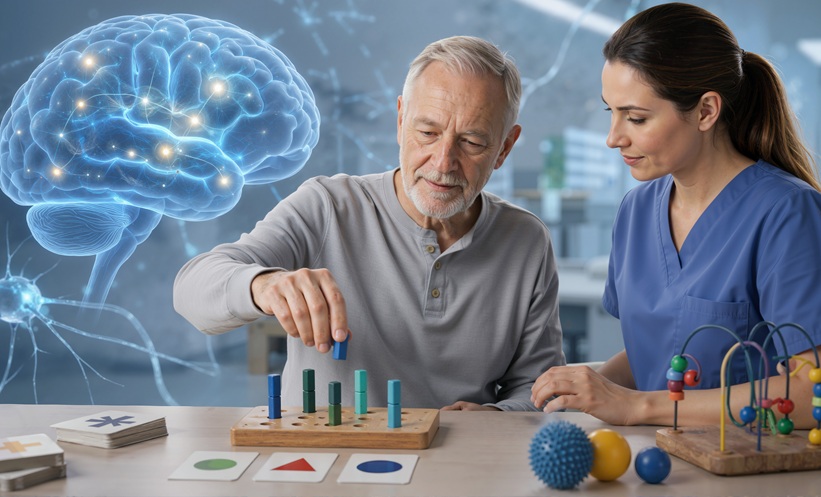
The multicentre, single-blind, two-arm randomised trial ran across three English sites between February 2023 and March 2024. It enrolled adults aged 30 to 60 with prior COVID-19 infection and objective cognitive impairment, defined as scoring at least one standard deviation below age norms in two or more cognitive domains. Of 78 participants randomised (mean age 47.3 years; 69.2% female), 38 received cognitive rehabilitation and 40 received usual care. In the rehabilitation arm, each participant received 10 weekly 1-hour telehealth sessions to work on 3 selected goals (eg, “I will write a report for 30 minutes without breaks, twice a week.”) often related to returning to work or improving work performance. Goals were addressed sequentially, with 3 sessions dedicated to each goal. Participants in the control group received the standard of care provided by current clinical services for long COVID.
Large and Sustained Functional Gains
At three months, goal attainment was significantly higher with cognitive rehabilitation than usual care, with an adjusted mean difference of 2.88 (95% CI 2.03 to 3.73; P<.001) and a large effect size (Cohen d = 1.57). Adjusted mean scores were 7.84 for rehabilitation versus 4.97 for usual care. The advantage persisted at six months, with an adjusted mean difference of 1.72 (95% CI 0.86 to 2.57; P<.001; Cohen d = 0.91). The rehabilitation group held steady over time (7.46), while the usual-care group partly caught up (5.74). Participants receiving rehabilitation also reported greater satisfaction with their goal performance.
Implications for Long COVID Services
The authors concluded that individualised, goal-oriented cognitive rehabilitation produced significant and durable improvements in functional goal attainment for people with long COVID cognitive impairment. Because targeting self-selected goals kept the therapy clinically relevant, they suggested the findings could shape how rehabilitation services are designed and delivered for this group. They noted the trial slightly under-recruited against its target of 88 participants, so larger studies would help confirm the durability of benefit.
Reference
Vanova M et al. Cognitive rehabilitation and functional outcomes in long covid–related cognitive impairment: a randomized clinical trial. JAMA Netw Open. 2026;9(7):e2620687.
Featured image: OlgaNeuroArt on Adobe Stock
- Author: