Endocrine Disruptors, Steroid Hormones, and Their Role in Gestational Diabetes - European Medical Journal

This site is intended for healthcare professionals

Endocrine Disruptors, Steroid Hormones, and Their Role in Gestational Diabetes

1 Mins
Reproductive Health
Download PDF
Authors:
* Michaela SvojtkovA , 1 Lucie Kolátorová , 1 Tereza Škodová , 1 Daniela Vejražková , 2 Kateřina Anderlová , 3,4 Patrik Šimják , 3 Karolína Adamcová , 3 Jana Vítků 1
  • 1. Department of Steroids and Proteofactors, Institute of Endocrinology, Prague, Czechi
  • 2. Department of Molecular Endocrinology, Institute of Endocrinology, Prague, Czechia
  • 3. Department of Gynecology, Obstetrics and Neonatology, First Faculty of Medicine, Charles University and General University Hospital, Prague, Czechia
  • 4. 3rd Department of Medicine – Department of Endocrinology and Metabolism, First Faculty of Medicine, Charles University and General University Hospital, Prague, Czechia
*Correspondence to [email protected]
Disclosure:

Vítků, Vejražková, Svojtková, Škodová, and Kolátorová received support for the present study from the Ministry of Health of the Czech Republic (MHCR–RVO project; Institute of Endocrinology–EÚ 00023761), with payment to the institution. The other authors have declared no conflicts of interest.

Acknowledgements:

The authors would like to thank Luboslav Stárka for his professional guidance and introduction to the topic of endocrine disruptors.

Citation:
EMJ Repro. ;12[1][Suppl 1]:62-63. https://doi.org/10.33590/emjreprohealth/IO0LB9JK.
Keywords:
11-ketotestosterone, bisphenols, diabetes, parabens.

Each article is made available under the terms of the Creative Commons Attribution-Non Commercial 4.0 License.

BACKGROUND AND AIMS 

The growing use of substances that affect the endocrine system (endocrine disruptors [ED]), together with evidence of their role in the development of Type 2 diabetes (T2D), has led to the hypothesis that EDs may contribute to the rising incidence of gestational diabetes (GD).1-4  The aim of the authors’ study was to describe exposure to selected EDs in women diagnosed with GD compared to a control group and to identify changes in the steroid spectrum in relation to ED exposure and GD.

MATERIALS AND METHODS 

Ninety-seven pregnant women were involved in the study (55 with diagnosed GD [fetuses: 30 male and 25 female] and 42 healthy controls [fetuses: 15 male and 27 female]). The authors collected maternal blood two times during pregnancy, at delivery, 3 days after delivery, and 6 months after delivery, and collected mixed fetal cord blood5 after delivery. In all samples, steroids (nine C21 steroids, nine androgens, three oestrogens, and their conjugates) and EDs (bisphenols A, S, F, P, AF, AP, methylparaben, ethylparaben, propylparaben, butylparaben, benzylparaben, and their conjugates) were analysed using liquid chromatography-tandem mass spectrometry.6,7 Data were statistically analysed using the Mann–Whitney test, with fetal sex considered.8

RESULTS 

The differences between women with GD and controls were as follows: women carrying a male fetus had a lower level of conjugated ethylparaben and butylparaben, as well as lower conjugated androstenedione, conjugated progesterone, conjugated and free 5α-dihydroprogesterone, pregnenolone, 11-deoxycortisol, 11-deoxycorticosterone, and higher 11-ketotestosterone.1  Meanwhile, there were no differences in women carrying a female fetus.1 Important results were found in cord blood: the authors demonstrated the shift from bisphenol A to alternative bisphenols, compared to the authors’ previous study, where no alternative bisphenols were found in cord blood.9 In the cord blood of girls (those who were offspring of women with GD), there were higher levels of conjugated butylparaben and lower levels of dehydroepiandrosterone and oestradiol. In the cord blood of boys (those who were offspring of women with GD), there were higher levels of bisphenol A and bisphenol S1 (Figure 1).
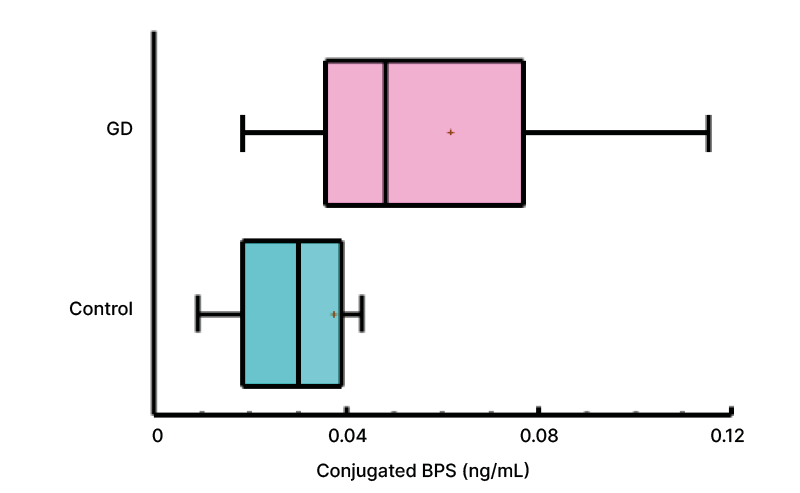
Figure 1: Conjugated bisphenol S levels in mixed umbilical blood (male fetus) detected in both newborn groups.
The red cross indicates the mean value. Significantly, there were higher levels of BPS in the group whose mothers had GD compared to the control group.
GD: gestational diabetes; BPS: bisphenol S.

CONCLUSION

The authors demonstrated the occurrence of ED not only in pregnant women, but also in their offspring, where a higher level was found in the offspring of women with GD. The authors also observed alterations in steroid levels in women with GD carrying a male fetus,1,9 some of which have been described in the literature in male patients with T2D.10

References
Svojtková M et al. Endocrine disruptors, steroid hormones and its role in gestational diabetes mellitus. Abstract. ISGE Congress, 4-6 March, 2026. Alonso-Magdalena P et al. Bisphenol A exposure during pregnancy disrupts glucose homeostasis in mothers and adult male offspring. Environ Health Perspect. 2010;118(9):1243-50. Ehrlich S et al. Endocrine disruptors: a potential risk factor for gestational diabetes mellitus. Am J Perinatol. 2016;33(13):1313-8. Yan D et al. Endocrine-disrupting chemicals and the risk of gestational diabetes mellitus: a systematic review and meta-analysis. Environ Health. 2022;21(1):53. Pašková A et al. Steroid metabolome in the umbilical cord: is it necessary to differentiate between arterial and venous blood? Physiol Res. 2014;63(1):115-26. Kolatorova Sosvorova L et al. Determination of selected bisphenols, parabens and estrogens in human plasma using LC-MS/MS. Talanta. 2017;174:21-8. Vitku J et al. Development and validation of LC-MS/MS method for quantification of bisphenol A and estrogens in human plasma and seminal fluid. Talanta. 2015;140:62-7. Adamcová K et al. Steroid hormone levels in the peripartum period – differences caused by fetal sex and delivery type. Physiol Res. 2018;67(Suppl 3):S489-97. Kolatorova L et al. Prenatal exposure to bisphenols and parabens and impacts on human physiology. Physiol Res. 2017;66(Suppl 3):S305-15. Allaoui G et al. Longitudinal assessment of classic and 11-oxygenated androgen concentrations and their association with type 2 diabetes mellitus development: the Tromsø study. Acta Diabetol. 2024;61(7):847-57.

Rate this content's potential impact on patient outcomes

Average rating / 5. Vote count:

No votes so far! Be the first to rate this content.