Key Summary:
- Improved peripheral airway function was associated with severe asthma remission.
- Half of biologic recipients met the three component remission definition.
- Oscillometry may complement spirometry when monitoring biologic response.
IMPROVED peripheral airway function was associated with clinical remission after biologic therapy in adults with severe asthma.
The real world study included 237 adults receiving specialist care for severe asthma. Of these, 127 received add on biologic therapy and 110 continued standard care without biologics. Researchers assessed lung function, airway reactance, inflammatory biomarkers, exacerbations, corticosteroid use, and symptom control over approximately 1 year.
Three component remission required no exacerbations, no maintenance oral corticosteroids, and an Asthma Control Questionnaire score below 1.5. Four component remission added stable forced expiratory volume in 1 second (FEV1).
Among patients receiving biologic therapy, 50.4% achieved three component remission and 34.6% achieved four component remission. The corresponding rates with standard care were 42.6% and 25.0%. However, differences in remission rates between the groups were not statistically significant.
Biologic therapy significantly improved FEV1, oscillometry measurements, Type 2 inflammatory biomarkers, exacerbation frequency, and symptom control. Baseline fractional exhaled nitric oxide concentrations of at least 25 parts per billion were also associated with greater odds of both remission outcomes among biologic recipients.
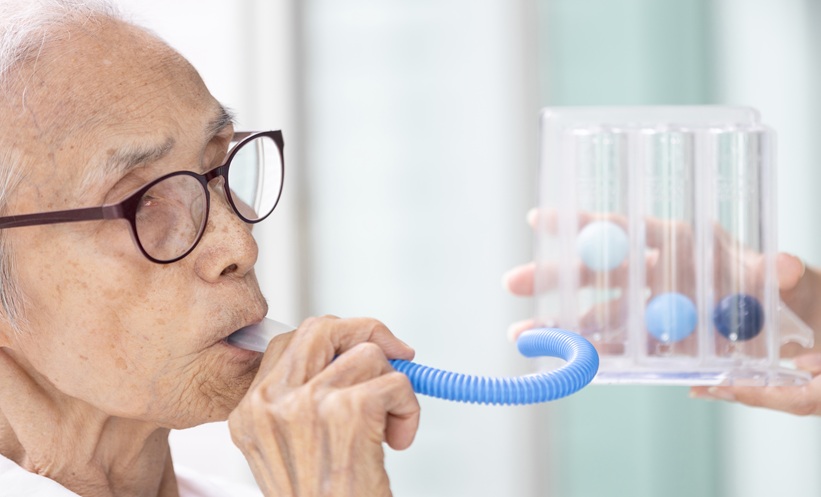
Oscillometry measures airway resistance and reactance during normal breathing, allowing clinicians to assess small airways dysfunction that may not be detected through spirometry.
A clinically meaningful improvement in the oscillometry derived area under the reactance curve of at least 0.65 kPa/L was associated with 2.61 times the adjusted odds of four component severe asthma remission after biologic therapy.
An FEV1 increase of at least 100 mL was also strongly associated with remission. It corresponded to 2.56 times the odds of three component remission and 11.2 times the odds of four component remission.
In the standard care group, greater peripheral airway stiffness at baseline was associated with a lower likelihood of three component remission.
The findings suggest that physiological improvement in the peripheral airways may accompany severe asthma remission across different biologic mechanisms. Oscillometry could therefore complement symptoms, exacerbation history, corticosteroid use, and spirometry when clinicians evaluate treatment response.
The retrospective design, modest cohort size, wide confidence intervals, and use of a single oscillometry platform limit the conclusions. Remission rates also cannot be directly compared as evidence of treatment superiority because the groups differed clinically at baseline. Larger prospective studies are needed to establish whether oscillometry can reliably predict or monitor remission in routine practice.
Reference
Lim JV et al. Improved peripheral airway reactance is associated with clinical remission after biologic therapy in severe asthma. Ann Allergy Asthma Immunol. 2026;10.1016/j.anai.2026.07.026.
Featured Image: Satjawat on Adobe Stock.
Each article is made available under the terms of the Creative Commons Attribution-Non Commercial 4.0 License.