Primary Cardiac Involvement in Early Systemic Sclerosis: Baseline Profile of the Patients in the SOLAR Registry - European Medical Journal

This site is intended for healthcare professionals

Primary Cardiac Involvement in Early Systemic Sclerosis: Baseline Profile of the Patients in the SOLAR Registry

2 Mins
Rheumatology
Download PDF
Authors:
* Shirkhan Amikishiyev , 1 Betül Dikkanoğlu Demirok , 2 Ayse Cefle , 2 Mehmet Engin Tezcan , 3 Esra Genç , 3 Duygu Ersözlü , 4 Burak Okyar , 4 Gezmis Kimyon , 5 Cemal Bes , 6 Aysenur Yilmaz , 6 Erdem Bektas , 6 Tahsin Murat Turgay , 7 Müçteba Enes Yayla , 7 Mehmet Akif Baltaci , 8 Busra Firlatan Yazgan , 9 Reyhan Bilici , 10 Fatma Alibaz-Oner , 11 Aysegul Avcu , 11 Abdurrahman Tufan , 12 Abdulsamet Erden , 12 Ibrahim Karaduman , 12 Atalay Dogru , 13 Zubeyde Ugurlu , 13 Abdurrahman Soner Senel , 14 Tuğba Kahraman Denizhan , 14 Ozlem Dogan Agbuga , 15 Ahmet Karatas , 16 Gulsah Yamancan , 16 Orhan Zengin , 17 Fatih Albayrak , 17 Berna Yurttas , 18 Ali Sahin , 19 Arif Babayigit , 19 Didem Arslan , 20 Ovgu Bickici , 20 Sukran Erten , 21 Orhan Kucuksahin , 21 Serdar Can Güven , 21 Gulen Hatemi , 22 Bercemhan Sulu , 22 Bengisu Aslan , 23 Timuçin Kaşifoğlu , 24 Dilara ISIYEL , 24 Tahir Saygin Ögüt , 25 Mustafa Ozmen , 26 Sinem Burcu Kocaer , 26 Aslihan Avanoglu Guler , 27 Veli Yazısız , 28 Handan Yarkan Tugsal , 29 Merih Birlik , 29 Süleyman Serdar Koca , 16 Alper Sari , 8 Mustafa Erdogan , 11 Duygu Temiz Karadag , 2 Ali Akdogan , 9 Yasemin Yalçınkaya , 1 Murat Inanc;1 on behalf of SOLAR (Systemic sclerOsis Longitudinal Assessment Registry) database
  • 1. Division of Rheumatology, Department of Internal Medicine, Istanbul Faculty of Medicine, Istanbul University, Türkiye
  • 2. Division of Rheumatology, Department of Internal Medicine, Faculty of Medicine, Kocaeli University, Türkiye
  • 3. Division of Rheumatology, Department of Internal Medicine, Kartal Dr. Lutfi Kirdar City Hospital, Istanbul, Türkiye
  • 4. Division of Rheumatology, Department of Internal Medicine, Adana City Hospital, Türkiye
  • 5. Division of Rheumatology, Department of Internal Medicine, Faculty of Medicine, Hatay Mustafa Kemal University, Türkiye
  • 6. Division of Rheumatology, Department of Internal Medicine, Basaksehir Cam and Sakura City Hospital, Istanbul, Türkiye
  • 7. Division of Rheumatology, Department of Internal Medicine, Faculty of Medicine, Ankara University, Türkiye
  • 8. Division of Rheumatology, Department of Internal Medicine, Ankara Etlik City Hospital, Türkiye
  • 9. Division of Rheumatology, Department of Internal Medicine, Faculty of Medicine, Hacettepe University, Ankara, Türkiye
  • 10. Division of Rheumatology, Department of Internal Medicine, Konya City Hospital, Türkiye
  • 11. Division of Rheumatology, Department of Internal Medicine, Faculty of Medicine, Marmara University, Istanbul, Türkiye
  • 12. Division of Rheumatology, Department of Internal Medicine, Faculty of Medicine, Gazi University, Ankara, Türkiye
  • 13. Division of Rheumatology, Department of Internal Medicine, Faculty of Medicine, Suleyman Demirel University, Isparta, Türkiye
  • 14. Division of Rheumatology, Department of Internal Medicine, Faculty of Medicine, Erciyes University, Kayseri, Türkiye
  • 15. Department of Rheumatology, Osmaniye Training and Research Hospital, Türkiye
  • 16. Division of Rheumatology, Department of Internal Medicine, Faculty of Medicine, Firat University, Elazig, Türkiye
  • 17. Division of Rheumatology, Department of Internal Medicine, Faculty of Medicine, Gaziantep University, Türkiye
  • 18. Division of Rheumatology, Department of Internal Medicine, Tekirdag Ismail Fehmi Cumalioglu City Hospital, Türkiye
  • 19. Division of Rheumatology, Department of Internal Medicine, Faculty of Medicine, Sivas Cumhuriyet University, Türkiye
  • 20. Division of Rheumatology, Department of Internal Medicine, Faculty of Medicine, Cukurova University, Adana, Türkiye
  • 21. Division of Rheumatology, Department of Internal Medicine, Ankara Bilkent City Hospital, Türkiye
  • 22. Division of Rheumatology, Department of Internal Medicine, Cerrahpasa Faculty of Medicine, Istanbul University-Cerrahpasa, Türkiye
  • 23. Division of Rheumatology, Department of Internal Medicine, Antalya Training and Research Hospital, Türkiye
  • 24. Division of Rheumatology, Department of Internal Medicine, Faculty of Medicine, Eskisehir Osmangazi University, Türkiye
  • 25. Division of Rheumatology, Department of Internal Medicine, Antalya City Hospital, Türkiye
  • 26. Division of Rheumatology, Department of Internal Medicine, Faculty of Medicine, Izmir Katip Celebi University, Türkiye
  • 27. Division of Rheumatology, Department of Internal Medicine, Ufuk University Faculty of Medicine, Ankara, Türkiye
  • 28. Division of Rheumatology, Department of Internal Medicine, Faculty of Medicine, Akdeniz University, Antalya, Türkiye
  • 29. Division of Rheumatology, Department of Internal Medicine, Faculty of Medicine, Dokuz Eylul University, Izmir, Türkiye
*Correspondence to [email protected]
Disclosure:

The authors have declared no conflicts of interest.

Keywords:
Early disease, primary cardiac involvement (pCI), pulmonary arterial hypertension, Systemic Sclerosis Longitudinal Assessment Registry (SOLAR), systemic sclerosis (SSc).
Citation:
EMJ Rheumatol. ;13[1]:44-47. https://doi.org/10.33590/emjrheumatol/L0998JF7.

Each article is made available under the terms of the Creative Commons Attribution-Non Commercial 4.0 License.

BACKGROUND AND AIMS

Primary cardiac involvement (pCI) is a major contributor to morbidity and mortality in systemic sclerosis (SSc). In routine practice, early cardiac manifestations may be under-recognised, particularly when systematic screening is not performed.

This study aimed to determine the baseline prevalence and clinical correlates of pCI in the SOLAR (Systemic Sclerosis Longitudinal Assessment Registry) and to summarise incident pCI during follow-up.1

MATERIALS AND METHODS

The authors conducted a cross-sectional baseline analysis with a longitudinal follow-up description using data from the SOLAR. The baseline cohort comprised 372 patients who fulfilled the 2013 American College of Rheumatology/European Alliance of Associations for Rheumatology (ACR/EULAR) classification criteria for SSc,2 representing an early SSc population with a disease duration of up to 3 years. pCI was defined as myocardial, pericardial, coronary, or conduction system abnormalities attributable to SSc. Baseline demographic, clinical, and laboratory variables were compared between patients with and without pCI using Fisher’s exact test or Welch’s t-test, as appropriate. Follow-up was assessed using available follow-up visits conducted at 6-month intervals to identify incident pCI among patients who were pCI-negative.

RESULTS

At baseline, pCI was present in 24/372 patients (6.5%), and most patients who were pCI-positive were female (79.2%). In available component fields, coronary artery disease was the most frequently recorded manifestation (16/24), whereas heart failure (1/24) and pericardial effusion (1/24) were uncommon. Patients with pCI were older than those without (56.7±15.4 versus [vs] 50.4±12.8 years; p=0.063). Skin subtype distribution differed (p=0.018), with diffuse cutaneous and sine scleroderma proportionally more frequent among patients who were pCI-positive. Myositis (12.5% vs 1.7%; p=0.016), pulmonary arterial hypertension (33.3% vs 3.2%; p<0.001), overlap syndrome (33.3% vs 9.8%; p=0.003), and hypertension (41.7% vs 16.1%; p=0.004) were also more common in the pCI group, while interstitial lung disease showed a non-significant numerical increase (52.2% vs 34.1%; p=0.112). Capillaroscopy patterns were available in 276 patients and were similar between groups (p=0.195), although late patterns were numerically more frequent with pCI (21.1% vs 8.6%; Table 1). Diabetes was numerically higher in the pCI group (16.7% vs 8.3%) but did not reach statistical significance (p=0.252).
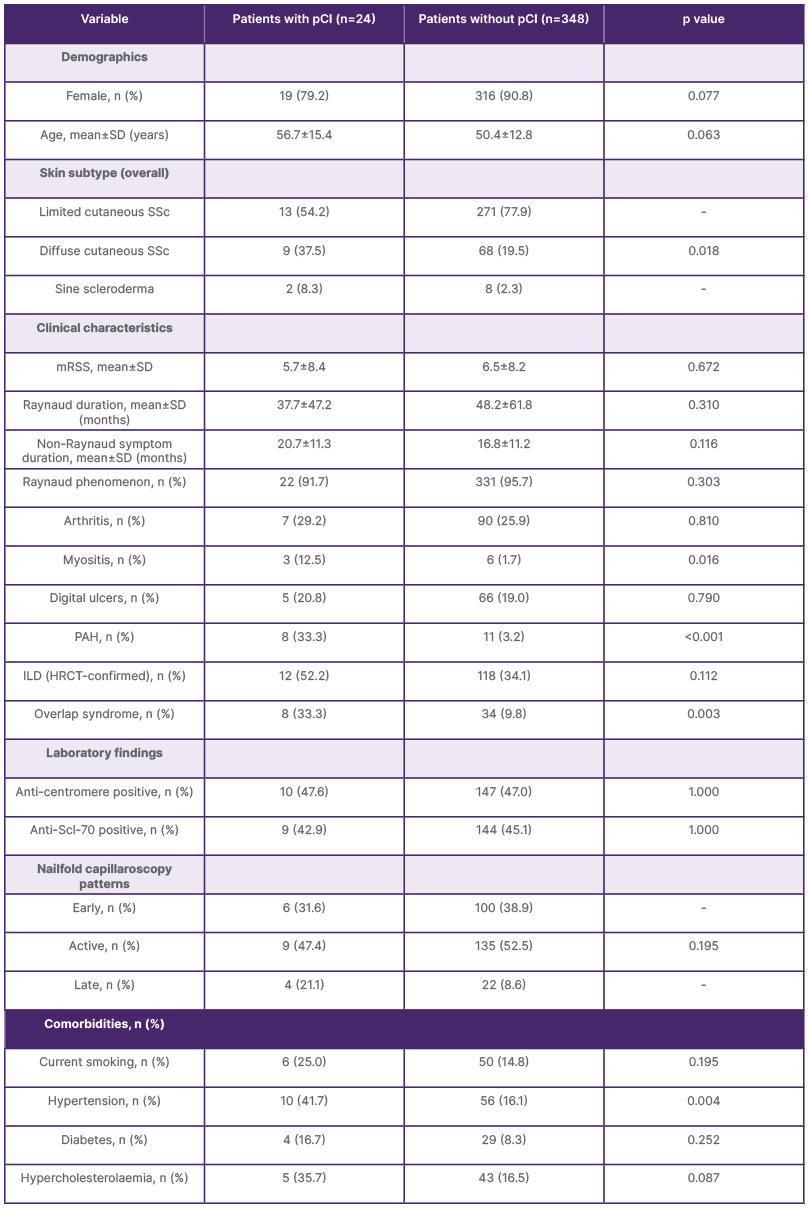
Table 1: Baseline characteristics of patients with and without pCI.
Anti-Scl-70: anti-topoisomerase I antibody; HRCT: high-resolution CT; ILD: interstitial lung disease; mRSS: modified Rodnan skin score; PAH: pulmonary arterial hypertension; pCI: primary cardiac involvement; SSc: systemic sclerosis.

Associated factors for pCI included older age (odds ratio [OR]: 1.04 per year; 95% CI: 1.00–1.07; p=0.024), diffuse cutaneous subtype (OR: 2.47; 95% CI: 1.04–5.88; p=0.041), myositis (OR: 8.07; 95% CI: 1.89–34.56; p=0.005), pulmonary arterial hypertension (OR: 15.27; 95% CI: 5.40–43.20; p<0.001), overlap syndrome (OR: 4.62; 95% CI: 1.84–11.58; p=0.001), and hypertension (OR: 3.72; 95% CI: 1.58–8.81; p=0.003). Limited cutaneous SSc was associated with a lower risk of pCI (OR: 0.34; 95% CI: 0.14–0.78; p=0.011). Among patients without pCI at baseline and with follow-up pCI data (n=275), six (2.2%) developed incident pCI, first detected at visit two in five patients and at visit three in one; overall, 30/372 patients (8.1%) had pCI recorded at least once across visits one to four.

CONCLUSION

In this early SSc registry cohort, pCI was documented in a minority of patients at baseline, which may partly reflect real-world reporting practices and the likelihood that subclinical disease is under-captured in a registry setting. Nevertheless, pCI clustered with a higher-risk clinical profile, particularly diffuse skin involvement, pulmonary arterial hypertension, myositis/overlap features, and hypertension. The emergence of new pCI cases during follow-up suggests that a single baseline assessment may miss evolving cardiac involvement, supporting structured and repeated cardiac evaluation in SSc, especially in patients with multisystem disease.

References
Amikishiyev S et al. Primary cardiac involvement in early systemic sclerosis: baseline profile of the patients in the SOLAR registry. Abstract OP0215. EULAR Congress, 3-6 June, 2026. van den Hoogen F et al. 2013 classification criteria for systemic sclerosis: an American College of Rheumatology/European League Against Rheumatism collaborative initiative. Ann Rheum Dis. 2013;72(11):1747-55.

Rate this content's potential impact on patient outcomes

Average rating / 5. Vote count:

No votes so far! Be the first to rate this content.