Abstract
Electronic consultations (eConsults) have emerged as an innovative option to improve access to rheumatology care and optimize referral triage, allowing for timely specialist input. As their use continues to expand, identifying the characteristics of effective eConsults is crucial to maximizing their clinical value. This feature summarizes the distinguishing features of high- and low-quality rheumatology eConsults and identifies current challenges in evaluating eConsult quality and success, emphasizing the need for standardized templates, clearer definitions of successful outcomes, and alignment among key stakeholders. Defining these elements will substantiate consistent implementation, improve patient care, and guide future research aimed at optimizing rheumatology eConsult programs.
Key Points
1. Electronic consultations (eConsult) in rheumatology have the potential to improve access to specialty care and streamline triage processes.2. The key features of a high- versus low-quality eConsult are reviewed and summarized.
3. To define a successful eConsult, we need a clearer definition of success, standardized templates, and stakeholder alignment, which paves the way for optimizing outcomes and future research.
INTRODUCTION
Across medical specialties, an electronic consult (eConsult) is generally defined as an asynchronous, structured communication between clinicians utilising a shared electronic medical record. Most studies on eConsults have focused on those originating from primary care providers (PCP), but, as eConsult programs become more established, a growing number of eConsults occur between specialists.1 While the mechanics of an eConsult are generally entrenched and similar across healthcare institutions, the authors propose that the fundamental purpose of this tool, and by extension what constitutes a successful eConsult, is less clear. eConsults have been examined for their ability to improve access to speciality care, namely as a triage tool for incoming referrals.2 Far less is known about the impact of eConsult systems on clinical outcomes, particularly in rheumatology, but this is a firmly set metric of success in medicine. Understanding the role of rheumatology eConsults in high-value care frameworks, including patient-centered outcomes, will be of greater importance as healthcare delivery models change over time.
In this article, the authors aim to investigate their current understanding of the function of eConsults in rheumatology. An analysis of 1 year of the authors’ respective eConsult data highlights regional variability in eConsult template design and questions utilization, raising thought provoking questions about a lack of standardization. Building off these observations, the authors highlight key features of high- versus low-quality eConsults from the perspective of the contributing authors, who represent three geographically and demographically distinct rheumatology practices. The authors postulate that defining success across stakeholders is crucial to inform future studies and to ultimately improve eConsult systems in evidence-based, meaningful ways. As eConsult programs mature and more data become available, we will be better positioned to not only quantify changes in access and make iterative improvements in eConsult systems, but also to move beyond process metrics to assess the impact of eConsults on clinical outcomes in rheumatology, including time to evaluation, diagnosis and subsequent disease activity, and management.
ACCESS TO SPECIALTY CARE
Out of all the possible metrics that eConsults are evaluated by, their contribution to the perennial and increasingly pressing goal of improving access to specialty care has received much of the attention. Just as there are varying definitions of success for eConsults, there are several ways to measure access, including wait times for consultations, timeliness of a response to a clinical question between clinicians, and effective triage of patients supporting efforts to align the right patient with the right provider at the right time through the right modality.
The success of eConsults both in improving access and as a triage tool can be difficult to assess and compare across studies given a lack of standardized outcome metrics. In a 2015 systematic review of eConsults across all specialties, Vimalananda et al.3 found limited empirical studies with qualitative or quantitative analysis of effects and subsequently broadened their review to include workflow processes and descriptive statistics. The authors see this trend in studies focused on rheumatology, including in their attempts to analyze their own data, and it is in part due to the challenges inherent in quality improvement analytics, but also likely stems from the specialty’s myriad goals for eConsults.
A study of eConsults to rheumatology by Rostom et al.4 demonstrated improvement in at least two metrics of access to care: a mean response time from a rheumatologist of 2.8 days and avoidance of an initial contemplated in-person referral in 38% of 224 total eConsults to rheumatology. In this paper, surveys of referring providers reporting anticipated avoidance of an in-person visit were used as an outcome measure. This provides useful information regarding the perceived value of eConsults for referring PCPs, but leaves open the possibility that a proportion of these patients may be referred for in-person evaluation sooner or later, especially given that patient perspectives were not assessed. More directly, Patel et al.5 utilized quality improvement science to demonstrate shorter wait times for the 88/139 positive antinuclear antibody (ANA) referrals seen in-person, which constitutes an important outcome when we consider the high volume of referrals for positive ANAs observed across the authors’ health networks (Figure 1). Within the University of Vermont Health Network (UVMHN) Division of Rheumatology, the authors of this work demonstrated a mean response time (expressed as ‘turnaround time’) of 0.64 days for 509 consults received, a significant improvement in access to specialty care compared to the approximate 9-month wait for an in-person visit to the authors’ division during the same time period.6˙
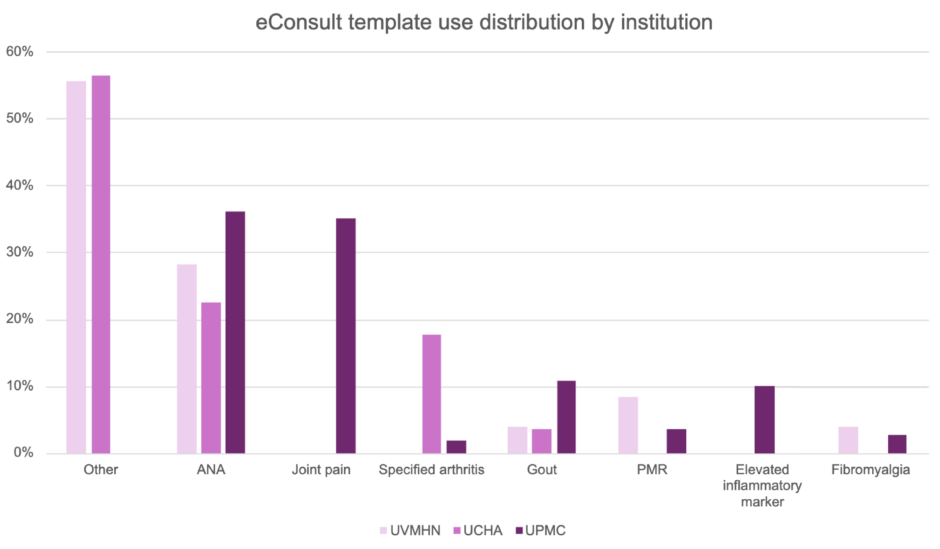
Figure 1: eConsult template use distribution by institution.
Distribution of eConsults, classified by template used (UVMHN, UCHA) or diagnosis (UPMC).
ANA: antinuclear antibody; eConsults: electronic consultations; PMR: polymyalgia rheumatica; UCHA: University of Colorado Hospital Authority; UPMC: University of Pittsburgh Medical Center; UVMHN: University of Vermont Health Network.
The authors envision that with increased uptake of rheumatology eConsults, more positive ANAs, for instance, would be appropriately addressed and diverted from in-patient visits, but this does not answer the more fundamental access question: does identification and diversion of referrals deemed inappropriate for in-person evaluation via a well-functioning eConsult system allow for better access to care for patients with rheumatologic disease. Or, to the contrary, will we succumb to a Jevon’s paradox whereby the ease and efficiency of eConsults fuels their increased utilisation for questions that would not have been sent to rheumatology in the absence of an efficient eConsult system.7 Further studies examining individual eConsult indications while applying analytical methods that account for the significant noise inherent in referral systems are needed to define the role of eConsults in improving access to rheumatologic care.
When looking at eConsult utilization data from each individual’s institution from this perspective, there is noteworthy variability between these geographically distinct organizations. These program evaluation data are a representative sample of 1 year of eConsults categorized by eConsult template (University of Colorado Hospital Authority [UCHA] and UVMHN) or primary diagnosis (University of Pittsburgh Medical Center [UPMC]). The ‘Other’ category captures eConsult questions in which the requesting provider could not find an appropriate eConsult template, and accounts for the majority of templates utilized at UCHA and UVMHN. Positive ANA eConsults are the second most common category across all institutions, which demonstrates an effective use of an eConsult system. The other category is not an intentionally designed template option, and its frequency presents an important opportunity to understand the implications of template design decisions on the quality of eConsult exchanges. If further analysis of the ‘Other’ category demonstrates significant heterogeneity in eConsult questions, this would support its ongoing use to maintain the greatest flexibility in the system. If, however, the authors find a high volume of a smaller group of questions, they may expand the panel to incorporate these indications to allow for standardization and efficiency in responses.
WHAT CONSTITUTES A HIGH-QUALITY RHEUMATOLOGY eCONSULT?
Beyond refined eConsult templates, the foundation of a high-quality eConsult relies on how the ordering provider frames an eConsult and its purpose from the patient’s perspective. If the ordering provider does not invest the small amount of time to explain the ‘nuts and bolts’ of an eConsult, the path to an unsuccessful eConsult will begin. Ordering providers should strongly consider setting aside time to review the rheumatology recommendations from the eConsult with the patient, either through an eVisit (email messages), a home video visit, or an in-person office visit. Building off this foundation, the communication exchange needs to be tailored to eConsults to be fully successful.
In order to review the elements of a high-quality rheumatology eConsult in contrast to a low-quality eConsult, the authors will use the example of two different eConsults ordered for the same reason, a positive ANA. For this exercise, the patient is a 52-year-old female. First, looking at the order for the eConsult, the referral reason for the high-quality eConsult is as follows: “Patient found to have a positive ANA. I would appreciate guidance in developing an appropriate differential diagnosis and any recommended additional evaluation.” Upon reviewing the electronic medical record, the ordering provider’s recent office visit note is completed in detail, and the encounter is closed. All relevant laboratory testing results are easily accessed. The ordering provider documents the reason for ordering the ANA along with a detailed history of present illness, review of systems, and physical exam (PE). PE includes an appropriate joint exam, including pictures of the affected joints where possible. The patient has baseline testing in addition to the ANA, including a complete blood count with differential, comprehensive metabolic panel, erythrocyte sedimentation rate, C-reactive protein, thyroid testing, and urinalysis.
In contrast, the low-quality eConsult for the same reason includes the referral reason stating, “positive ANA.” There are no specific questions in terms of the recommendations and guidance that are desired. There is no documentation as to why the ANA test was ordered initially and it is difficult to find the results of the ANA test as it was done several months ago at an outside lab. At the time the eConsult is placed, the ordering provider’s note is not complete, and the encounter remains open. The ordering provider explains to the patient that the ANA test was positive and only a rheumatologist can explain the result. The goal conveyed to the patient is a quicker rheumatology in-person visit, a way to ‘jump to the front of the line’. Once completed, there are gaps in the note itself, including a minimal PE without a musculoskeletal exam. The review of systems is minimal, with no symptom details provided in the history of present illness, simply “chronic joint pain and fatigue.”
These two examples highlight the key components of an eConsult exchange: a clear clinical question with supportive documentation and appropriate communication between referring provider and patient, and referring provider and specialist (Table 1).
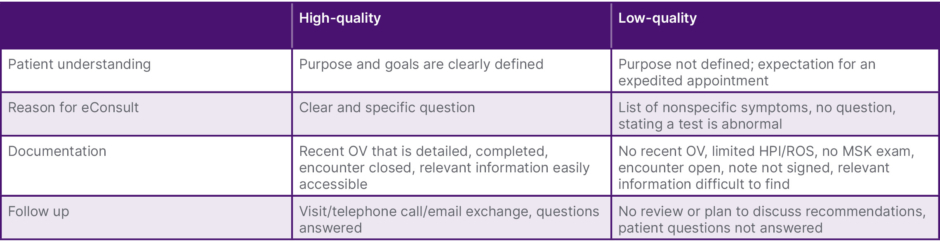
Table 1: Key features of eConsults.
eConsults: electronic consultations; HPI: history of present illness; MSK: musculoskeletal; OV: office visit; ROS: review of systems.
In addition to defining a high-quality eConsult question for the rheumatologist, it is important to consider what constitutes a high-quality eConsult response for the referring provider. A 2020 study done by Tran et al.8 identified features of high-quality eConsults for future incorporation into an assessment tool for specialists completing eConsults;8 the assessment tool by Tran et al. was published in 2022.9 Both Tran et al. studies (development and subsequent use of the assessment tool), while not encompassing rheumatology eConsults specifically, provide key points that can be applied to the current discussion and future studies. Eight PCPs and three specialists (dermatology, hematology, and pediatric orthopedics) were part of the study.8 The features of a high-quality eConsult correspondence included the following 10 items: specific management details; all concerns fully addressed with relevant, patient-specific and personalized advice; current/up-to-date information along with the standard of care; specific treatment details; actionable advice; clarity; anticipatory guidance; respectful and professional tone; timeliness; and when to refer for an in-person visit.8 Most of these features are applicable as rheumatologists review their own eConsult recommendations to ensure high-quality exchanges, particularly relevant are the anticipatory guidance and specific management guidance given the role of eConsults in facilitating care delivery. Caution must be used, however, when comparing different specialist eConsult correspondences as each specialty has unique aspects of eConsult recommendations, purposes, and goals. Along these lines, considering specific treatment details may be less relevant to rheumatology eConsults when applied to clinical questions centering on diagnostic uncertainty as opposed to treatment uncertainty. As discussed above, rheumatology eConsults are used in a variety of different ways, including new referral screening and triage, recommendations for workup before an in-person visit, and providing guidance when an in-person office visit is not needed. Thus, a high-quality eConsult correspondence must be defined by the context in which it was used, its purpose from the perspective of referring provider, patient, and specialist, and the quality of the initial request.
Not only do specialists and referring providers benefit from high-quality eConsults, there are also advantages to the patient and the healthcare system. eConsults facilitate enhanced care coordination, cost and time savings, and swift responses to patient concerns efficiently.
FUTURE DIRECTIONS
It is clear that eConsults are here to stay and for the authors, all of whom work within established eConsult systems, they have great potential to enhance patient care. The authors of this work do recognize opportunity for improvement, and how input from professional societies, regarding the role of eConsults, could offer guidance within each specialty, as they design and refine their systems. Within rheumatology, we need to clarify how and for what purpose eConsults are used within and across institutions in order to establish outcome measures suitable for rigorous analysis. As a first step, the current authors see benefit in well-constructed surveys of PCPs, patients, rheumatologists, and healthcare institutions to establish the goals of eConsults across these different stakeholders. This clarity of purpose is essential for designing future studies that are able to ask and answer questions relevant to these complex systems and their constituent components.
From the authors’ observations of their own systems, the authors of this work see value in analyzing the growing utilization of ‘Other’ as an eConsult question, as there are several potential explanations and implications for this trend. Capturing the ordering provider type for each eConsult question may reveal more ‘Other’ eConsults originating from specialist rather than PCPs. Specialists are more likely to have questions unique to their field; for example, the significance of an autoantibody discovered in the workup for interstitial lung disease or liver disease, for which eConsult templates are not available. Conversely, we may find that an uptick in the use of ‘Other’ is driven by PCPs, in which case we need to understand if there was an existing template better suited to their question that was not used, or if template offerings should be expanded to allow for increased efficiency for both referring provider and specialist. Perhaps the ‘Other’ category should be eliminated in favor of a fixed number of question templates that best capture the goals for eConsults. The authors see several benefits to refinement and standardization of templates, including the ability to observe trends over time, comparison between institutions, and for pooling data across institutions. A potential drawback of eConsult template standardization is a loss of responsiveness to the changing needs and goals of an individual system due to forces that are demographic and financial, and the possible negative impact of standardization on regional specialization.
Lastly, the authors of this work suggest that future studies are needed to evaluate the impact of eConsults on cost and quality of care with well-defined outcome metrics, including the value of eConsult by type and as a triage tool. As healthcare delivery systems change, the ultimate goal is to demonstrate the essential role of eConsults in a high-value care framework.
CONCLUSION
In summary, rheumatology eConsults have significant potential to enrich triage efficiency, improve access to specialty care, and sustain high-value care delivery. However, a great deal of variability exists in rheumatology eConsult strategy and usage, creating a significant need for clear definitions of success, support among stakeholders, and homogeneous templates. In order to elevate the role of rheumatology eConsults, future directions should concentrate on process measures, patient-centered care, and consequential clinical outcomes.