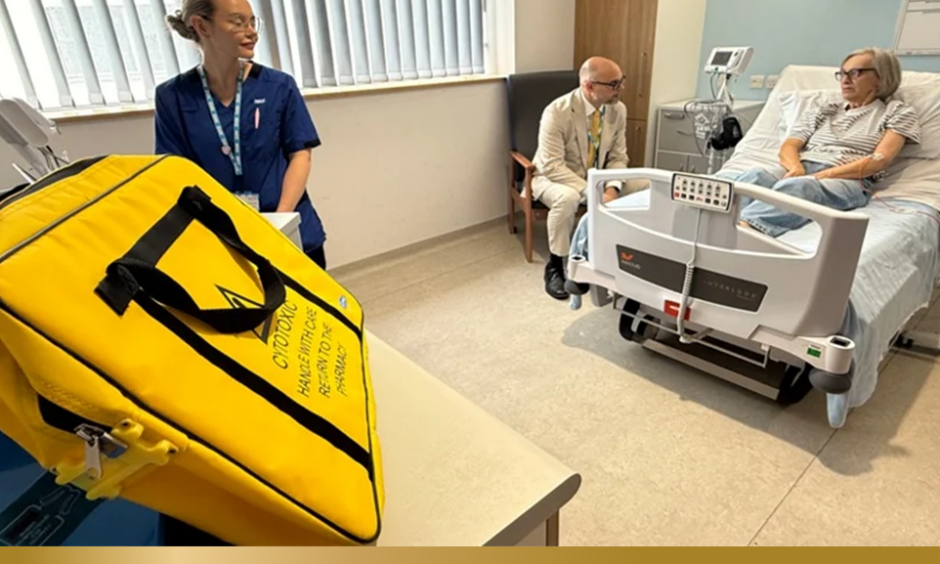
Researchers and clinicians from the University of Liverpool and the Clatterbridge Cancer Centre (CCC) are leading a first-in-human international clinical trial to investigate a personalised lung cancer vaccine.
The team, which includes the Liverpool Clinical Trials Centre, is studying a bespoke vaccine which is designed to target the unique genetic changes found in each patient’s tumour.
World-first vaccine milestone
A patient with advanced non-small cell lung cancer (NSCLC) whose disease has only partially responded to immunotherapy, has become the first person in the world to receive this personalised cancer vaccine designed to help the immune system identify and attack tumour cells.
In the UK, around 50,000 people are diagnosed with NSCLC each year, with two million cases globally, making it the third most prevalent cancer in the world.
The vaccine is created using computational technology to identify tumour-specific targets and a synthetic DNA platform known as ‘doggybone DNA’ (dbDNA).
The CCC researchers believe the inclusion of the dbDNA technology will, in future, play an important role in making personalised cancer vaccines capable of delivery at scale.
A new route for advanced lung cancer
The phase 1 NEOVACC trial, backed by a £2.66m Medical Research Council grant, brings together cancer specialists, immunologists, genetic scientists, clinical trial experts, NHS teams and industry partners.
The study is led by Professor Christian Ottensmeier, CCC Consultant Oncologist, and Professor Natalia Savelyeva, who are both part of the University of Liverpool’s Institute of Systems, Molecular and Integrative Biology.
Prof Christian Ottensmeier, CCC Consultant Oncologist and Chief Investigator, said: “This personalised approach could offer hope to those for whom standard immunotherapy has not fully worked, by helping the immune system recognise and fight the parts of the tumour that have previously evaded detection.
“We are excited to be using ‘doggybone’ technology in the creation of this vaccine, which has the potential to be a gamechanger in reducing the speed and cost of production of these important therapies.”
Dr Carles Escriu, CCC Medical Oncology Consultant and University of Liverpool Senior Clinical Lecturer, said:
“While a minority of patients experience long‑term benefit from immunotherapy, most either do not respond or eventually develop resistance.
“This study is unique internationally – not only because of the novel technology, but because it focuses on a substantial and clinically important group: patients who respond initially but are at high risk of developing resistance.”
Featured image: University of Liverpool