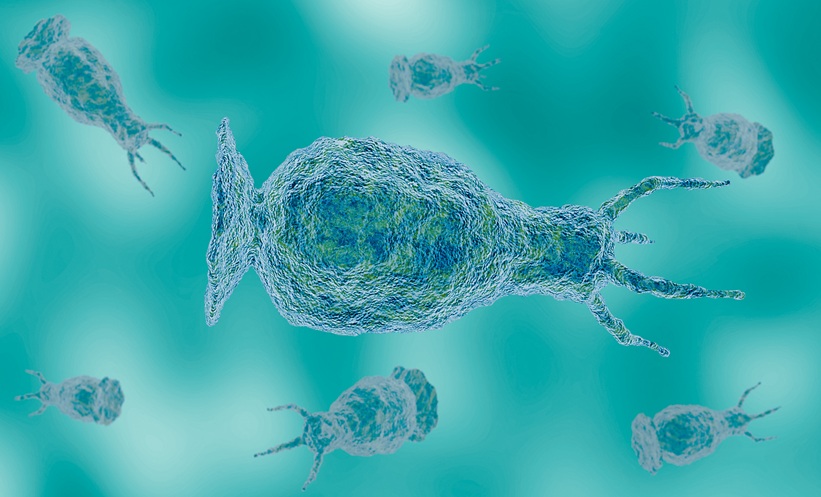
NEW research reveals how Naegleria fowleri utilizes narrow anatomical confinement to rapidly migrate into central nervous pathways. Primary amoebic meningoencephalitis carries an extraordinary case fatality rate of approximately 95 percent, disproportionately claiming the lives of children following recreational freshwater exposure. While clinicians recognize that trophozoites enter through nasal passages during aquatic activities, the exact cellular biophysics governing their rapid traversal across the cribriform plate have long eluded medical science. By evaluating cellular navigation across distinct microenvironments, investigators established that these amoebae possess an intrinsic preference for tight physical spaces, an adaptation termed claustrophilia that directly accelerates neurotropic invasion.
Confinement-Seeking Behavior in Naegleria Fowleri Invasion
When navigating unconfined flat surfaces, amoebae dynamically utilize both actin-rich lamellar protrusions and membrane blebs. However, upon encountering physical channels measuring four to eight micrometers in width, which closely mimic the tight interstitial spaces flanking human olfactory axons, the cells switch exclusively to bleb-based motility. Unlike other studied amoebae that frequently disengage from channel interfaces, these organisms actively probe narrow apertures until entry occurs, demonstrating interface entry rates between 65 and 100 percent without requiring chemical attractants or fluid flow. Once inside moderate eight-micrometer channels, Naegleria fowleri model cells almost double their migration velocity to approximately 31 micrometers per minute. They maintain near-perfect directional persistence across runs approaching two millimeters, displaying sustained polarity without reversing direction.
From Environmental Foraging to Fatal Meningoencephalitis
Investigations using three-dimensional granular hydrogel matrices designed to simulate pond sediments demonstrated that amoebae readily burrow into dense particulate environments while maintaining directional memory over extended timescales. In freshwater habitats, the combination of orientation memory, confinement-seeking claustrophilia, and persistent channel migration functions to optimize bacterial foraging between tightly packed silt particles. In a human host, however, these harmless environmental survival mechanisms become lethal pathogenic drivers. Inhaled amoebae leverage directional memory to navigate the nasal cavity, utilize claustrophilia to slip into the narrow sheaths of olfactory nerve bundles, and exploit rapid bleb-driven motility to penetrate the cribriform plate. This rapid mechanical transit delivers Naegleria fowleri directly into cerebral tissue before effective clinical management can be initiated.
Reference
Velle KB et al. Naegleria amoebae seek confinement and crawl persistently through narrow spaces. Proc Natl Acad Sci U S A. 2026;123(38):e2534165123.