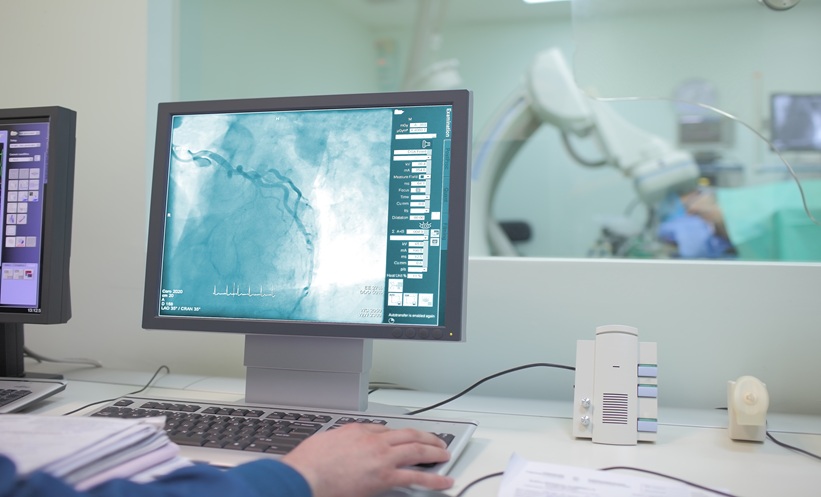
CORONARY angiography interpreted using a novel multiview artificial intelligence model accurately detected obstructive coronary stenosis and predicted 1-year cardiovascular events, demonstrating strong performance across a range of clinically relevant cardiovascular assessments.
AI-Driven Coronary Angiophraphy
Based on 203,808 angiographic videos from 28,117 patients, the model, DeepCORO-CLIP, was trained to analyse entire angiographic studies rather than individual images or videos.
The findings suggest that coronary angiography may provide substantially more prognostic information than previously recognised when combined with advanced AI methods.
The investigators developed the model using paired angiographic videos and catheterisation reports, enabling comprehensive analysis across multiple angiographic views.
For detection of obstructive stenosis of ≥70%, the model achieved an area under the receiver operating characteristic curve of 0.89, with a sensitivity of 0.85 and specificity of 0.70.
Coronary Angiography Predicts Future Cardiovascular Risk
Beyond anatomical assessment, the researchers evaluated whether coronary angiography could be used to predict future adverse outcomes.
In a cohort of 350 patients followed for up to 1 year, the model achieved an area under the receiver operating characteristic curve of 0.79 for composite major adverse cardiovascular events.
This exceeded the performance of a model based on routinely collected clinical variables, which achieved an area under the receiver operating characteristic curve of 0.65.
The model demonstrated particularly strong performance for predicting urgent revascularisation, achieving an area under the receiver operating characteristic curve of 0.82 compared with 0.64 for the clinical model.
Notably, incorporating clinical variables alongside the AI predictions did not meaningfully improve performance, suggesting that important prognostic information was already captured within the angiographic videos.
Clinical Utility and Future Applications
The researchers also found that the model could estimate left ventricular ejection fraction from coronary angiography alone.
It achieved a mean absolute error of 7.3% compared with 8.8% for a previously developed AI approach.
In a blinded assessment involving 365 report evaluations across 288 angiograms, AI-generated reports were considered clinically usable in 76% of evaluations, compared with 88% for cardiologist reports.
The main limitation was missed proximal stenoses rather than incorrect identification of disease.
Overall, the findings indicate that coronary angiography combined with multiview AI analysis could support diagnosis, risk stratification, and clinical decision making, while providing a foundation for future human-in-the-loop cardiovascular imaging workflows.
Reference
Harrabi S et al. A multiview video–text model detects obstructive coronary stenosis and predicts 1-year cardiovascular events from angiography. Nat Cardiovasc Res. 2026;DOI:10.1038/s44161-026-00890-8.