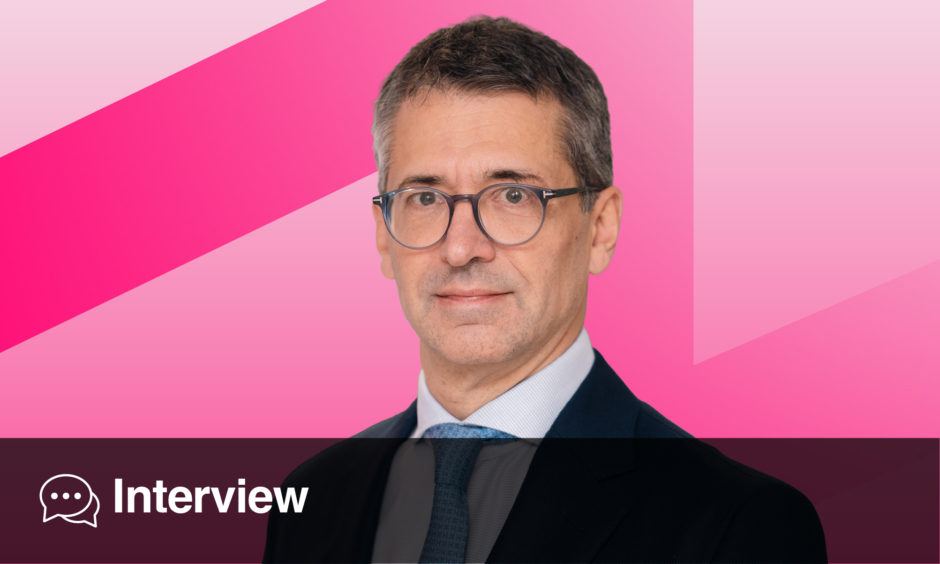
Marco Roffi | Professor of Cardiology; Director, Interventional Cardiology Unit, University Hospitals of Geneva, Switzerland; Vice President (2026–2028), European Society of Cardiology (ESC)
Citation: EMJ Cardiol. 2026;14[1]:78-80. https://doi.org/10.33590/emjcardiol/0X0JF023

You have contributed to interventional cardiology, clinical research, guideline development, and cardiovascular education throughout your career. Looking back, what originally inspired you to pursue cardiology, and what continues to motivate you today?
At the beginning of my training, I loved every topic in internal medicine, but I felt frustrated because I thought I would never become an expert, as the field was so extensive. Therefore, the choice of a sub-speciality was a natural for me. Being fascinated by the heart, I chose cardiology, convinced I could master the domain, which obviously was a major underestimation of the complexity of the field and an overestimation of myself. As I had the chance to train at the University of Bern, Switzerland, under the leadership of Professor Bernhard Meier, a pioneer of coronary angioplasty, getting into interventional cardiology was a no-brainer.
My motivation in the hospital these days is mainly driven by patient care (the patient is and should remain the centre of our attention) and the opportunity to teach and train younger colleagues. Beyond hospital work, my involvement with the European Society of Cardiology (ESC) is a great source of motivation.
You have been involved with the ESC Congress scientific programme for more than a decade and chaired the 2019 and 2020 editions. How have you seen the Congress evolve during that period, and what makes the ESC 2026 Congress particularly exciting?
Over the years, the ESC meeting has evolved to the number one cardiovascular meeting worldwide, not only in terms of attendance, but also in terms of quality. We are particularly proud when our American colleagues and friends tell us that ESC is the best congress!
Regarding the 2026 edition, the spotlight on AI could not be hotter!
Having recently been elected the ESC Vice President for the 2026–2028 term, what are your main priorities for the Society over the coming years, and how do you hope to help shape its future direction? What would you like your legacy within the ESC and the wider cardiology community to be?
First, I would like the ESC to be more inclusive. I would like to give the opportunity to more cardiologists, scientists, and allied profession representatives to have an active role within ESC activities. As an example, in order to give a broader spectrum of colleagues the opportunity to present or chair a session at the ESC Congress, I initiated the ‘Case Corners’ in 2019, which are dedicated spaces where cases are presented and discussed. This allows a new spectrum of people, who may not have the opportunity to do high-level research and frequently come from historically less represented countries, to have an active role in the largest cardiovascular congress in the world.
Second, as the burden of cardiovascular disease in low- and middle-income countries is growing exponentially, I dream that the ESC may have an impact in these regions, in line with its mission of reducing the burden of cardiovascular disease worldwide. The ESC is a well-respected society with massive know-how in education, science, meeting organisation, and data management, as well as having a solid network with other societies and industry. With so many great people involved in the Society, who better than the ESC to take on this challenge? Our attention should first be on the needs among national cardiac societies but, in line with the ESC spirit, we are called to serve beyond borders.
The ESC 2026 Congress places a spotlight on AI. Where do you see AI having the greatest clinical impact in cardiovascular medicine over the next decade?
There is no question that AI will massively impact cardiovascular medicine. The most immediate benefit may come from AI-based integration of demographics, symptoms, clinical findings, and laboratory values, as well as genetic and imaging data to help look for rare diagnoses, potentially guiding tailored treatments and providing individualised prediction of future clinical events. Overall, the impact of AI will be more far-reaching than we can anticipate.
You have worked in interventional cardiology through multiple transformative eras, from bare-metal stents to contemporary image-guided and physiology-guided interventions. What innovation has most fundamentally changed patient outcomes during your career?
We can practice interventional cardiology today thanks to the courage of Andreas Grüntzig, who dared in 1977 to inflate a bulky homemade balloon in a coronary artery. Many other great innovations have followed, driven by pioneers and technological developments, three of which have changed the life of patients and operators.
First, coronary (bare metal) stents, which prevent acute and sub-acute vessel occlusion following angioplasty and allow vessel patency in acute myocardial infarction.
Second, drug-eluting stents, which have massively reduced restenosis and the need for repeat revascularisation following percutaneous coronary interventions. In the era of bare-metal stents, we used to say to patients: “The result of today’s procedure is great, but we have a one-in-six chance of meeting again in 6 months.” And sometimes, the consequences of restenosis were far-reaching, such as the need for coronary artery bypass surgery.
Third, transcatheter aortic valve implantation, which alleviates symptoms and prolongs life, in elderly patients with aortic stenosis who have no other options, and beyond. The risk today is indications being pushed to the limit, raising ethical questions around residual benefit, futility, and affordability.
Much of your research has focused on acute coronary syndromes, antiplatelet therapy, and coronary artery disease in patients with diabetes. Which unanswered questions in these areas do you believe deserve the greatest attention from researchers today?
The current one-size-fits-all approach to the duration and intensity of antiplatelet therapy following coronary stenting is calling for refinement. In patients with chronic coronary syndromes undergoing bare-metal stent implantation, dual antiplatelet therapy (DAPT) consisted of aspirin and clopidogrel for 1 month. With the advent of drug-eluting stents, together with the miraculous reduction in restenosis rate, came the ‘Damocles’ sword’ of late and very late stent thrombosis, pushing DAPT duration to 12 months and beyond. Now that drug-eluting stent thrombosis has become exceedingly rare, we have to learn to tailor DAPT duration to the patient profile, not to the stent.
We are seeing increasingly personalised approaches to antithrombotic therapy and coronary intervention. How close are we to truly individualised treatment strategies for patients presenting with acute coronary syndromes?
Currently, we are using the same drugs, with the same dosing, and in the same combinations for the vast majority of patients. Initial steps to tailor treatment have been undertaken, looking at DAPT duration as well as antiplatelet therapy de-escalation. Individualised medicine is warranted, ideally estimating for each patient their own ischaemic/bleeding risk. One of the major challenges in risk assessment is that, frequently, parameters associated with ischaemic risk influence bleeding risk at the same time. I expect a major improvement in risk assessment with the assistance of AI, taking into account all the known parameters associated with the benefits or harms of antiplatelet therapy.
You have served as an ESC representative to India, China, and the Middle East. How important is global collaboration in cardiology today, and what can European cardiologists learn from colleagues working in other regions?
The ESC is regarded internationally as a scientific leader, and many non-European countries follow ESC guidelines and have representatives attending the ESC Congress. I’ve been struck on multiple occasions by how friendly and eager to interact with the ESC cardiologists from around the world are.
In some aspects of cardiology, other areas of the world are leading; for example, the volume of interventional procedures performed in some centres in China is unparallelled. From these relationships, the ESC is also strengthened.
Finally, for early-career cardiologists attending ESC 2026, what is one message you hope they take away from this year’s Congress?
Come not only for the science, but also to meet people and build bridges. In a world full of incertitude, this is more important than ever.