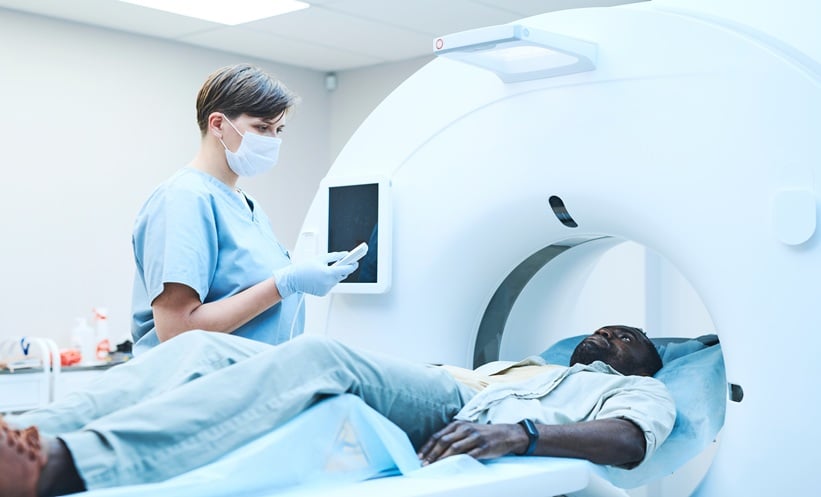
NEW treatment for earlier stage rectal cancer could spare patients from undergoing complex and life-changing surgery, major new research shows.
The University of Birmingham and Leeds University ran an international trial assessing the outcome of treating patients with early-stage rectal cancer with chemoradiotherapy, finding that the organ preserving treatment could be an option for many.
An Alternative to Invasive Surgery
Currently, the foremost treatment for the 4,100 people diagnosed with early-stage rectal cancer in the UK each year is radical surgery that removes the whole rectum.
The invasive surgery often leaves patients with life-changing side-effects including bowel dysfunction, sexual and urinary-tract issues and a permanent colostomy bag.
Now, the study shows that replacing the surgery with a combination of chemo and radiotherapy could be a viable and effective option for many, allowing them to avoid the potential risks and life-long costs of the operation.
Over 500 patients with the early-stage diagnosis were recruited from across United Kingdom, Netherlands, Denmark, Belgium and Sweden and split into three groups; one who received the standard treatment of radical surgery, and two who each received new treatments that aimed to preserve organs.
One non-surgery group received five weeks of chemoradiotherapy, the other underwent five days of radiotherapy. Patients in these groups were only given radical surgery if treatment alone was not shrinking their tumour enough.
Where small areas of cancer persisted, these were removed by rectum-preserving surgery – a smaller, less invasive operation that is reduces the chance of side effects.
After a period of 12 months, the chemoradiotherapy course of treatment was found to be more effective at reducing the need for surgery than the radiotherapy alone, with four in five patients treated with chemoradiotherapy keeping their rectum.
Also after a year, the estimated surgery-free survival was 78·5% for those in the chemoradiotherapy group compared to 60·6% in the radiotherapy only group.
Researchers will now follow the patients for the next three years to determine longer-term outcomes, whether their cancer is likely to return and whether there is a difference in survival for the non-surgical patients.
Hopes of a New Standard Treatment
Scientists say that the “exciting” landmark study may enable thousands to avoid such life-changing and risky surgery whilst also maintaining the opportunity to receive effective care and could eventually be offered as the standard course of treatment for early-stage rectal cancer.
David Sebag-Montefiore, co-chief investigator of the STAR-TREC trial and Professor of Clinical Oncology at the University of Leeds, said: “These exciting results are an example of how a smarter, kinder radiotherapy treatment may allow patients to avoid the need for major surgery.
“It is gratifying that patients experienced a relatively low level of severe short-term side effects as a result of the smaller, more targeted radiotherapy approach that we specifically developed for STAR-TREC.”
Prof Simon Bach, co-chief investigator of the STAR-TREC trial, Honorary Chair at the University of Birmingham and Professor of Colorectal Surgery at University College London, said: “For decades we’ve asked patients to accept the loss of their rectum – and often a permanent stoma – as the price of curing their cancer. These results suggest that for many people, this price no longer has to be paid.
“The next step is to confirm these results hold over the longer term, and then to make sure the approach is available to every patient who could benefit.”
Reference
Bach S et al. Chemoradiotherapy versus short-course radiotherapy for response-adapted organ preservation in early-stage and intermediate-stage rectal cancer (STAR-TREC): 12-month results of an international, multicentre, open-label, parallel-group, randomised, phase 2/3 trial. The Lancet Oncology. 2026; 0
Featured image: Mediaphotos on AdobeStock