Key Summary:
- Study compared three navigation strategies for PFNA fixation of hip fractures.
- Robotic navigation reduced anteversion attempts, fluoroscopy use and blood loss.
- Robotic efficiency improved with experience.
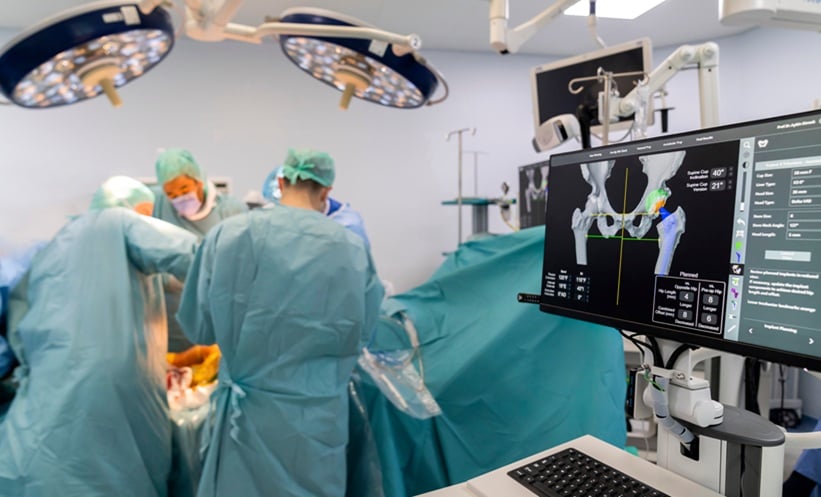
ROBOTIC navigation improved positioning efficiency and reduced fluoroscopy use and intraoperative blood loss during proximal femoral nail antirotation (PFNA) fixation for intertrochanteric fractures, according to a retrospective cohort study involving 121 patients. The findings suggest that full robotic navigation may offer perioperative advantages over partial robotic assistance and conventional freehand techniques, although anatomical factors continue to influence positioning accuracy.
Researchers retrospectively assessed 121 patients undergoing PFNA fixation, comparing three approaches: full robotic navigation in 41 patients, robotic navigation for the main nail with freehand anteversion determination in 40 patients, and conventional freehand fixation in 40 patients.
The number of attempts required to determine the anteversion angle was significantly lower with full robotic navigation, averaging 1.22 attempts compared with 4.30 with partial navigation and 3.98 with the conventional technique (both p<0.001). This indicated more consistent first attempt positioning with the fully navigated approach.
Full robotic navigation also reduced the fluoroscopy time span to 65.95 minutes, compared with 77.93 minutes using the conventional technique, representing a 15.4% reduction. The total number of fluoroscopy exposures decreased by 28.6%, from 56.93 to 40.63.
Visible intraoperative blood loss was 99.8 mL with full robotic navigation, compared with 219.3 mL with conventional fixation, a reduction of 54.5%. Blood transfusion requirements were also significantly lower, averaging 0.73 units compared with 2.14 units (p=0.002).
Despite the benefits associated with full robotic navigation, patient anatomy remained an important determinant of positioning accuracy. Within the fully navigated group, anteversion error showed a strong negative correlation with medullary canal diameter (r=−0.807; p<0.001).
Multivariable regression identified medullary canal diameter as the only independent predictor of anteversion error (β=−0.781; p<0.001). These findings highlight the importance of considering individual anatomical characteristics during preoperative planning, even when robotic assistance is used.
The partial navigation group also had a significantly longer main nail insertion time than the conventional group, averaging 43.78 minutes compared with 34.65 minutes (p=0.002). In contrast, the difference between full robotic navigation and conventional fixation was not statistically significant.
Learning curve analysis demonstrated a substantial reduction in fluoroscopy time span as surgeons gained experience with robotic procedures. The quadratic model showed a strong relationship between case order and fluoroscopy time span (R²=0.644; p<0.001), indicating early improvement followed by a gradual plateau.
The authors concluded that full robotic navigation could improve procedural efficiency and reduce intraoperative radiation exposure and blood loss during PFNA fixation. However, the retrospective design limits conclusions about causality, and further research is needed to establish whether these perioperative benefits translate into improved longer term patient outcomes.
Reference
Huang YY et al. Robotic navigation strategies for PFNA fixation: impact on one-time guide pin success rate and anteversion angle accuracy – a retrospective cohort study. J Robot Surg. 2026;20:1149.
Featured Image: ATRPhoto on Adobe Stock
Each article is made available under the terms of the Creative Commons Attribution-Non Commercial 4.0 License.