ARTIFICIAL intelligence (AI) assistance significantly improved clinician confidence in optical coherence tomography (OCT)-guided decision-making, according to research presented at EuroPCR 2026.
The findings suggested that AI support could help narrow the expertise gap between experienced and less experienced OCT users during percutaneous coronary intervention (PCI).
Optical Coherence Tomography and the Experience Gap
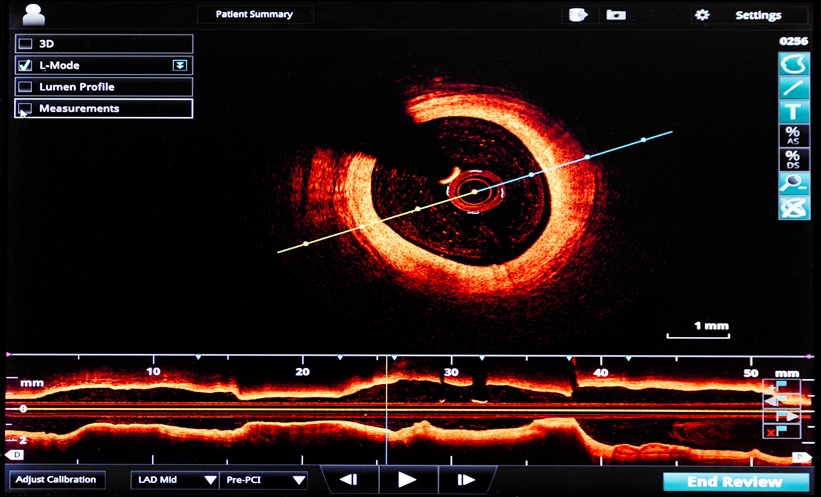
OCT is increasingly used in interventional cardiology to provide high-resolution imaging inside coronary arteries, helping clinicians guide stent placement, optimise procedures, and identify complications such as stent failure.
However, interpreting OCT images can require substantial experience, potentially limiting wider adoption in routine practice.
AI Support Improves Confidence
The international survey study included 43 clinicians involved in PCI, comprising 41 interventional cardiologists, one fellow-in-training, and one non-interventional cardiologist.
Participants self-rated their OCT experience and were divided into low-experience and experienced groups. Researchers then assessed clinician confidence across five OCT-guided indications before and after exposure to hypothetical AI-assisted visual support.
Across both groups, clinicians already viewed intracoronary OCT as highly valuable, particularly for stent optimisation, which received the highest ratings overall. However, baseline confidence differed substantially according to experience level.
Experienced OCT users reported the greatest confidence in guiding stent placement, while confidence was lowest for identifying stent failure. Among low-experience users, confidence levels were consistently lower, especially for high-risk plaque assessment.
AI Narrowed the Experience Gap
Following exposure to AI-assisted OCT examples, confidence scores increased across nearly all clinical domains. In experienced clinicians, significant improvements were observed for identifying stent failure, culprit lesion assessment, and high-risk plaque evaluation.
The impact was even more pronounced among low-experience users, whose confidence improved across every assessed indication. After AI support was introduced, confidence levels between experienced and low-experience clinicians no longer differed significantly.
The investigators suggested these findings highlighted AI’s potential to democratise OCT interpretation, enabling clinicians with less procedural imaging experience to feel more confident when making complex PCI decisions.
Potential Implications for Interventional Cardiology
AI-assisted OCT analysis is a rapidly expanding field within interventional cardiology, with growing interest in how automated image interpretation could support procedural planning and optimisation.
The current findings indicated that clinician trust and perceived usefulness may play a key role in determining whether these technologies are adopted more broadly in clinical practice.
Although the study was based on survey responses and hypothetical AI visualisations rather than real-world clinical outcomes, the authors concluded that AI support could facilitate wider OCT adoption regardless of prior clinician experience.
Further studies will now be needed to determine whether increased confidence translates into improved procedural accuracy and patient outcomes.
Reference
Van der Zande J et al. Impact of AI assistance on clinician confidence in OCT-guided decisions across experience groups. Abstract A101837Jv. EuroPCR 2026, 19-22 May, 2026.
Featured image: ATRPhoto on Adobe Stock
- Author: