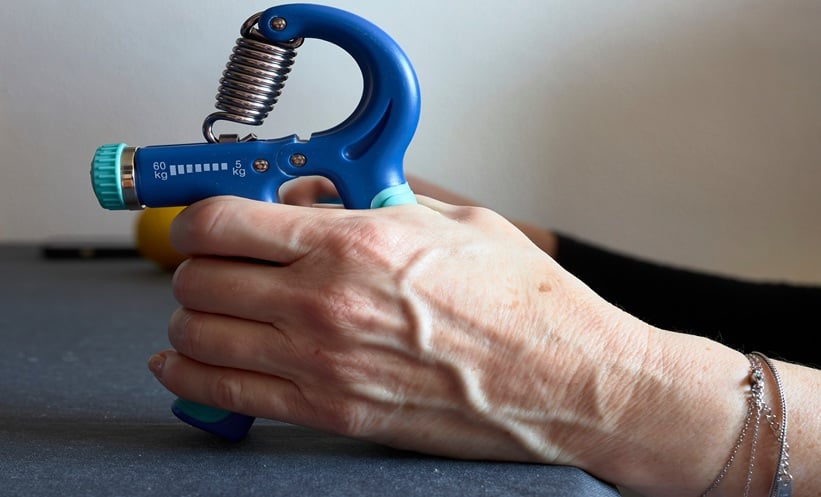
DEGNERATIVE CERVICAL MYELOPATHY risk was associated with both grip strength and walking pace in a large prospective cohort study, with stronger grip and faster self-reported walking pace linked to lower rates of subsequent hospital record defined degenerative cervical myelopathy (DCM).
Grip Strength Associated with Lower DCM Risk
Researchers analysed data from 501,936 participants and assessed whether grip strength and walking pace were associated with incident hospital record defined DCM.
During a median follow up of 16.43 years, 978 participants developed DCM, corresponding to an incidence of 12.31 cases per 100,000 person years.
The primary complete case analysis included 489,344 participants and 923 events.
After adjustment for age, sex, ethnicity, smoking status, body mass index, alcohol intake, diabetes, and hypertension, each 5 kg increase in grip strength was associated with a lower hazard of DCM.
Analysis showed the relationship was approximately linear, with no evidence of nonlinearity.
Walking Pace Reveals Graded Relationship
Walking pace was self-reported as brisk, steady or average, or slow. Compared with brisk walking pace, steady or average pace was associated with a higher hazard of DCM.
Slow walking pace was associated with an even greater risk. An ordinal trend analysis supported a graded association between slower walking pace and increasing DCM risk.
The findings remained directionally consistent across multiple sensitivity analyses, including alternative outcome definitions, exclusion of the first 2 to 5 years of follow up, and competing risk analyses accounting for death.
No significant interactions were observed according to sex or age group.
Implications for Future Diagnostic Research
The researchers also explored whether adding grip strength and walking pace to a clinical model improved risk discrimination.
They concluded that grip strength and walking pace are non-specific functional markers associated with future degenerative cervical myelopathy risk.
While these measures may help inform future prospective diagnostic studies, they should not be used as standalone screening or triage tools.
Reference
Yang S et al. Grip strength, walking pace, and hospital-record-defined incident degenerative cervical myelopathy: a UK Biobank cohort study. BMC Neurol. 2026;DOI:10.1186/s12883-026-05305-6.
Featured image: Ricardo on Adobe Stock