BACKGROUND AND AIMS
The Centers for Medicare & Medicaid Services (CMS) Transforming Episode Accountability Model (TEAM) is a mandatory 5-year, episode-based payment model launched in January 2026. Approximately 700 acute care hospitals across selected core-based statistical areas will be financially accountable for cost and quality across a 30-day post-discharge episode for five surgical categories, including spinal fusion and surgical hip/femur fracture treatment. Undiagnosed osteopenia or osteoporosis affects nearly half of patients undergoing spinal fusion, and poor bone quality markedly increases the risk of hardware failure, pseudarthrosis, fragility fractures, and downstream utilisation, positioning bone health optimisation (BHO) as a key driver of both clinical quality and episode-level financial performance under TEAM.
MATERIALS AND METHODS
The authors present a clinical and operational framework,1 developed by the National Spine Health Foundation’s Spine and Bone Health Task Force, to align preoperative BHO and Fracture Liaison Service (FLS) principles with TEAM accountability requirements (Figure 1). The framework comprises four integrated components: 1) a six-step preoperative screening algorithm using FRAX® (University of Sheffield, UK), dual-energy X-ray absorptiometry, Trabecular Bone Score (TBS), and CT Hounsfield Units, with risk stratification into low, moderate, and high categories; 2) a seven-step preoperative BHO checklist covering risk identification, screening documentation, International Classification of Diseases, 10th Revision (ICD-10) coding, active optimisation planning, evaluation and management coding considerations, diagnosis carry-forward, and use of modifier 22 when bone quality complicates surgery; 3) a 30-day postoperative playbook structured around the TEAM episode window with a 3–6 month bridge to long-term FLS-based management; and 4) operational alignment with TEAM’s mandatory primary care provider referral requirement to enable structured handoff of osteoporosis diagnosis, dual-energy X-ray absorptiometry results, supplementation plans, and pharmacologic therapy.
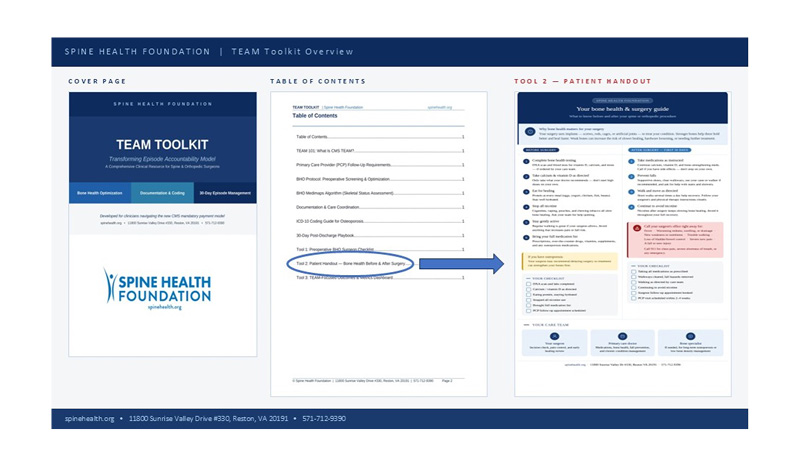
Figure 1: The TEAM Toolkit.
The TEAM Toolkit is the clinical and operational framework developed by the Spine Health Foundation. The cover page (left), table of contents (middle), and the patient handout tool (right) are shown here.
TEAM: Transforming Episode Accountability Model.
DISCUSSION
Three implications follow from this framework. First, although hospitals hold formal TEAM accountability, surgeon-level workflow decisions including preoperative bone status documentation, intraoperative fixation strategy for compromised bone, discharge disposition, and post-discharge follow-up directly determine episode reconciliation outcomes. Second, systematic ICD-10 coding for osteoporosis, osteopenia, vitamin D deficiency, and related risk factors protects target-price calculation through accurate risk adjustment. Third, TEAM’s mandatory primary care referral creates a structural bridge previously absent under fee-for-service, supporting long-term continuation of pharmacologic osteoporosis therapy beyond the surgical episode.
CONCLUSION
TEAM creates structural and financial alignment for systematic bone health programmes in USA acute care hospitals performing spine and orthopaedic surgery. By embedding preoperative BHO, standardised coding, and structured post-acute handoff into the surgical episode, hospitals can simultaneously reduce complications, lower episode costs, and expand FLS uptake in alignment with Capture the Fracture® standards (International Osteoporosis Foundation [IOF], Nyon, Switzerland). The framework presented offers a practical template for translating TEAM compliance into durable improvements in osteoporosis diagnosis and treatment for surgical patients.