Abstract
Background: The rapid expansion of robotic and minimally invasive surgery has created an urgent need for structured, simulation-based training beyond the traditional apprenticeship model. Current robotic surgery curricula commonly include didactics, virtual simulation, dry-lab training, bedside assistance, and supervised console experience; however, their content, assessment methods, and certification standards remain highly variable. 3D printing may address key gaps by providing patient-specific, anatomically accurate, and tactile models for surgical planning, rehearsal, and hands-on skills training.
Objective: To summarise the educational value of surgical simulation and 3D-printed models in modern surgical training, particularly within robotic surgery.
Methods: This narrative review was based on a literature search of PubMed, Scopus, and Google Scholar. Relevant studies on robotic surgery curricula, virtual reality simulation, proficiency-based training, objective assessment, and 3D-printed surgical models were identified and narratively synthesised.
Results: Simulation-based curricula support progressive skill acquisition in a safe environment before patient exposure. The Fundamentals of Robotic Surgery curriculum has demonstrated improved trainee performance in a multicentre randomised trial, supporting proficiency-based progression before clinical application. 3D-printed models provide additional value by improving spatial anatomical understanding, surgical confidence, procedural rehearsal, and patient-specific decision-making. In urology, these models have been most commonly applied to nephron-sparing surgery and prostate surgery, where complex anatomy and robotic loss of haptic feedback make tactile simulation particularly relevant. Recent systematic reviews report promising improvements in trainee anatomical understanding, technical performance, confidence, and familiarity with complex surgical steps, although studies remain heterogeneous and often small-scale.
Conclusion: Surgical simulation and 3D-printed models represent complementary tools for competency-based surgical education. Their integration into standardised curricula may improve trainee preparedness, reduce learning curves, and enhance patient safety. Future studies should validate objective performance metrics, cost-effectiveness, and clinical skill transfer within multicentre training programmes.
Key Points
1. Robotic and minimally invasive surgery are rapidly becoming standardised, creating a need for structured, simulation-based training beyond the traditional apprenticeship model.2. This narrative review summarises the educational value of surgical simulation and 3D-printed models in modern surgical training, particularly within robotic surgery.
3. Although further studies are required to validate objective performance metrics, cost-effectiveness, and clinical skill transfer, surgical simulation and 3D-printed models may serve as valuable complementary tools within competency-based surgical education.
INTRODUCTION
Surgical education has changed substantially, particularly over the last 2 decades. Traditional apprenticeship-based models, commonly summarised as ‘see one, do one, teach one’, were developed in an era with different operative volumes and lower technological complexity. Today, surgical training is increasingly shaped by minimally invasive and robotic techniques, requiring structured curricula, simulation-based education, and objective assessment methods.1
Among recent technological advances, robotic surgery has had a particularly profound impact on surgical training. Robotic systems provide several technical advantages, including 3D visualisation, tremor filtration, improved ergonomics, and enhanced dexterity. At the same time, these technologies require surgeons to develop entirely new psychomotor and technical skills compared to conventional open surgery.2 As robotic procedures rapidly expanded across urology, general surgery, gynaecology, and cardiothoracic surgery, concerns regarding how residents should be trained also became increasingly important.
In many institutions, the expansion of robotic surgery occurred faster than the development of standardised educational systems. Several studies demonstrated substantial variability between residency programmes regarding simulation access, resident console participation, curriculum structure, and technical assessment.3,4 Some residents gain early robotic exposure and structured simulator training, while others complete residency with relatively limited console experience. This inconsistency has become one of the major driving forces behind the growing interest in structured robotic curricula and simulation-based surgical education.
At the same time, simulation gradually shifted from being an optional educational adjunct to becoming an essential component of modern surgical training. Simulation-based education provides trainees with opportunities for repetitive practice outside the operating room without concerns regarding patient safety, operative stress, or time pressure.5 More recently, advances in 3D-printing technologies have further expanded surgical simulation by enabling the creation of anatomically realistic and patient-specific physical models.6 Taken together, these developments are reshaping surgical education towards a more structured, competency-based, and simulation-integrated model.
This narrative review summarises current evidence regarding standardised robotic surgery curricula, simulation-based education, objective assessment, and 3D printing in surgical training. Relevant literature was identified through PubMed, Scopus, and Google Scholar using combinations of keywords including “robotic surgery,” “robotic curriculum,” “simulation,” “virtual reality,” “3D printing,” and “surgical education.” Priority was given to peer-reviewed English-language articles, including systematic reviews, RCTs, consensus statements, and landmark educational studies. Studies were selected based on their relevance to the scope of this review. As this is a narrative review, no formal systematic review methodology or quality assessment was performed.
THE NEED FOR STANDARDISED ROBOTIC CURRICULA
One of the major problems in contemporary surgical education is the lack of uniformity between training programmes. Although robotic surgery is now widely integrated into surgical practice, educational pathways remain highly heterogeneous. A collaborative European study evaluating urology residency training showed that many residents believed they lacked sufficient operative exposure during residency, and trainee confidence strongly correlated with surgical volume and access to simulation resources.3
This variability is particularly evident in robotic surgery training. Tom et al.4 reported that although robotic exposure had become increasingly common in general surgery residency programmes in the USA, major differences still existed regarding curriculum structure, technical assessment, certification requirements, and resident console participation.4 These findings highlight an important educational challenge: technological advancement has progressed more rapidly than curriculum standardisation.
Several groups have therefore advocated for competency-based robotic curricula integrating simulation, objective assessment, and stepwise progression models.2,7 One of the most influential initiatives was the development of the Fundamentals of Robotic Surgery curriculum. Unlike procedure-specific pathways, the Fundamentals of Robotic Surgery programme was designed as a platform-independent and specialty-independent curriculum focusing on universal robotic skills, communication, safety, and psychomotor competency.8
Most modern robotic curricula now follow a sequential structure. Training usually begins with online didactic modules and simulation-based psychomotor exercises, followed by bedside assisting, console participation, and eventually supervised operative autonomy.9 However, progression through these stages is often inconsistent. Zhao et al.9 identified limited robotic case volume, inadequate console exposure, operating room hierarchy, and attending surgeons’ trust in trainee skills as major barriers affecting the transition from bedside assistant to console surgeon.
Because of these limitations, many authors emphasise that robotic surgical education should be competence-based rather than purely time-based. Schreuder et al.5 argued that robotic training should include objective assessment at every stage and rely on validated educational principles rather than informal operative exposure alone. Similarly, Ahmed et al.7 proposed an internationally standardised robotic curriculum incorporating simulation, cognitive training, procedural education, and formal assessment strategies.
Although the principles of competency-based robotic training are now widely accepted, considerable variability remains in how these curricula are implemented and evaluated. A recent systematic review by Basile et al.10 identified numerous robotic surgery simulators, assessment tools, and structured curricula, yet only a limited number demonstrated predictive validity or were supported by high-level evidence. Importantly, while Proficiency-Based Progression (PBP) curricula consistently outperformed traditional training methods in preclinical settings, relatively few existing curricula have fully incorporated objective performance metrics and validated proficiency benchmarks. These findings suggest that further efforts are required to establish robust, evidence-based educational pathways capable of ensuring reproducible training outcomes across institutions.10
Recent studies also suggest that structured robotic curricula improve resident preparedness and educational consistency. Madion et al.11 reported that nearly 70% of general surgery residency programmes in the USA now include formal robotic curricula, although significant variability still exists regarding implementation and resident autonomy. Hague et al.12 described the integration of robotics into residency training as an “unchecked technological revolution,” emphasising that technological dissemination has often outpaced educational oversight.12
Supporting this concept, the multicentre randomised PROVESA trial demonstrated that trainees completing a PBP curriculum for robotic suturing were significantly more likely to achieve predefined proficiency benchmarks than those receiving traditional training. Participants trained using PBP also committed substantially fewer technical errors, highlighting the educational value of objective performance metrics and benchmark-driven progression. These findings provide high-level evidence that standardised, proficiency-based curricula can improve the quality and consistency of robotic surgical training beyond conventional apprenticeship models (Table 1).13
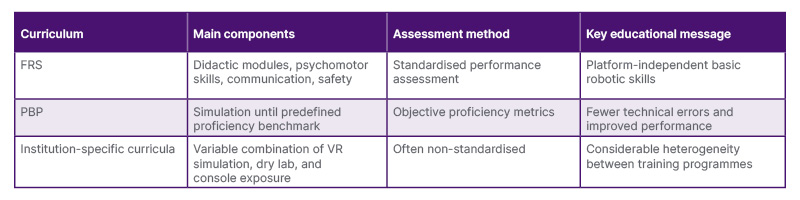
Table 1: Overview of the principal structured robotic surgery curricula, their educational components, assessment strategies, and key educational objectives.
FRS: Fundamentals of Robotic Surgery; PBP: proficiency-based progression; VR: virtual reality.
SIMULATION-BASED SURGICAL EDUCATION
Simulation-based training has become one of the central pillars of modern surgical education. Current simulation modalities include box trainers, cadaveric models, virtual reality simulators, augmented reality systems, animal laboratories, and patient-specific physical models.
One of the greatest strengths of simulation is the opportunity for repetitive practice. Trainees can perform the same technical manoeuvre multiple times without patient-related risk or intraoperative stress. Simulation also allows the development of psychomotor coordination and procedural familiarity before participation in live surgery.
The increasing complexity of minimally invasive surgery further accelerated the adoption of simulation-based education. Zhang et al.14 emphasised that procedures such as laparoscopic hepatobiliary and pancreatic surgery require navigation through intricate anatomical relationships under restricted tactile feedback conditions, making traditional apprenticeship models increasingly insufficient.
Among simulation modalities, virtual reality platforms have attracted significant attention in robotic surgery training. Moglia et al.15 concluded that robotic virtual reality simulators demonstrated strong face and construct validity, although evidence regarding skill transfer into the operating room remained relatively limited. More recent evidence has become increasingly supportive. Schmidt et al.16 demonstrated that technical skills acquired through robotic virtual reality simulators could be transferred into the operating room, while simulator performance also correlated with intraoperative performance metrics.
Similarly, Kiely et al.17 showed in an RCT that participants completing a proficiency-based virtual reality robotic suturing curriculum demonstrated significantly greater improvement in robotic suturing performance than controls. These findings suggest that simulation-based robotic education can accelerate early technical skill acquisition and shorten the initial learning curve.
Importantly, simulation also improves educational reproducibility. Unlike opportunistic operative exposure, simulation ensures that trainees encounter standardised tasks and comparable educational experiences. This consistency is particularly valuable in robotic surgery, where institutional variability remains substantial.
Beyond technical skills acquisition, simulation has become an integral component of structured robotic training pathways. Contemporary curricula increasingly combine multiple simulation modalities, including didactic teaching, dry-laboratory exercises, virtual reality simulation, bedside assistance, and supervised console training, rather than relying on a single educational platform. Such multimodal approaches allow trainees to progressively acquire cognitive knowledge, psychomotor skills, and procedural competence within a standardised educational framework. Recent systematic reviews suggest that combining complementary simulation modalities provides a more comprehensive learning experience than isolated simulation techniques alone.18
However, no single simulation modality perfectly reproduces live surgery. Virtual reality simulators provide unlimited procedural repetition and objective performance metrics, but often lack realistic haptic feedback. Physical models offer greater tactile realism, but may fail to replicate dynamic physiological responses such as tissue perfusion or bleeding. Consequently, many educational programmes now favour hybrid simulation ecosystems integrating multiple modalities (Table 2).
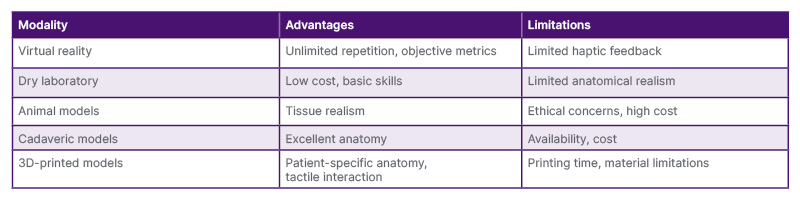
Table 2: Advantages and limitations of major simulation modalities.
THE EMERGING ROLE OF 3D-PRINTED MODELS
Among recent developments in simulation-based education, 3D printing has emerged as one of the most promising technologies. By converting radiological imaging datasets into patient-specific physical models, 3D printing allows realistic anatomical replication for procedural planning and surgical training.6
Unlike purely virtual simulation systems, 3D-printed models provide direct instrument interaction and tactile feedback. This physical realism is particularly valuable in robotic and minimally invasive surgery, where depth perception, instrument handling, and spatial orientation are critical technical components.
Applications of 3D printing in surgical education continue to expand rapidly. Langridge et al.6 demonstrated successful implementation of 3D-printing technologies across multiple specialties including neurosurgery, orthopaedics, vascular surgery, otolaryngology, and urology. Reported benefits included improved anatomical understanding, enhanced procedural planning, increased trainee confidence, and accelerated technical skill acquisition.
Within urology, 3D printing has been increasingly used for robotic partial nephrectomy, pyeloplasty, renal transplantation, ureteroscopy, and pelvic surgery simulation. Campi et al.19 developed the first entirely 3D-printed robotic kidney transplantation simulator, known as the ‘RAKT Box’, specifically designed for robotic vascular training. Their work illustrated how highly specialised robotic procedures could be translated into realistic simulation environments.
Beyond procedure-specific simulation, 3D printing has become an increasingly versatile educational platform throughout surgical training. Recent systematic reviews have demonstrated that 3D-printed models are now integrated across numerous surgical specialties and are used not only for procedural simulation, but also for anatomical teaching, preoperative planning, and resident education. Their high degree of anatomical fidelity and customisation allows trainees to rehearse both common procedures and uncommon anatomical scenarios in a standardised environment. Similar findings have also been reported in colorectal surgery, where 3D-printed models have been shown to improve anatomical education and preoperative visualisation, although further advances in printing materials are still required to achieve higher-fidelity procedural simulation. Furthermore, trainee satisfaction with 3D-printed simulation has consistently been reported to be high, supporting its growing incorporation into modern surgical curricula.20,21
Another major advantage of 3D printing is personalisation. Patient-specific models can replicate complex anatomical variations and pathological conditions that may rarely be encountered during routine residency training, thereby supporting precision surgical education and individualised procedural rehearsal. Beyond surgeon training, these models have also emerged as valuable tools for patient education by improving patients’ understanding of anatomy, planned surgical procedures, and doctor–patient communication, further broadening the educational impact of 3D printing.22
Repeated training using realistic 3D-printed models has also demonstrated measurable educational benefits. Xia et al.23 showed that trainees practising laparoscopic intracorporeal intestinal anastomosis on 3D-printed models achieved significant improvements in technical performance and learning curves. Similar benefits have been reported in hepatobiliary surgery, where a recent systematic review found that 3D-printed models improved operative performance, enhanced anatomical understanding, and increased trainee confidence across a variety of educational settings. Collectively, these findings suggest that realistic physical simulation can facilitate technical skill acquisition and procedural confidence across different surgical specialties.24
Despite these encouraging findings, several challenges continue to limit the widespread implementation of 3D-printed simulation. Although recent advances in printing technology have reduced manufacturing costs and improved model accessibility, the production process still requires image segmentation, technical expertise, and dedicated printing infrastructure. In addition, accurately reproducing tissue biomechanics, vascular perfusion, and bleeding remains challenging, limiting the realism of current models. Consequently, most authors advocate integrating 3D-printed simulators with complementary educational modalities rather than considering them complete replacements for cadaveric, animal, or virtual reality simulation.25,26
INTEGRATION OF 3D PRINTING INTO SURGICAL CURRICULA
Despite increasing enthusiasm surrounding 3D-printing technologies, integration into formal surgical curricula remains inconsistent. Most current applications remain institution-specific rather than universally standardised. Nevertheless, evidence increasingly supports incorporating realistic physical simulation models into structured educational pathways.
Barron et al.27 emphasised that simulation training using congenital 3D cardiac models improved technical performance and facilitated skill transfer into the operating room. Importantly, they argued that simulation should no longer be viewed as an optional adjunct, but rather as a routine component of modern surgical education.
Effective integration of 3D printing into curricula requires alignment between educational objectives and simulation design. Models developed for anatomical teaching differ substantially from those intended for procedural rehearsal or competency assessment. Consequently, simulation fidelity should be tailored according to the targeted educational outcome.
The future likely lies in hybrid educational systems combining online didactics, virtual simulation, physical 3D-printed models, bedside participation, and supervised operative progression. As competency-based education continues to evolve, simulation and 3D-printing technologies will likely become central components of surgical curricula rather than supplementary educational tools.
CONCLUSION
Modern surgical education is transitioning from traditional apprenticeship-based models towards structured, competency-based, simulation-integrated training systems. The rapid expansion of minimally invasive and robotic surgery has accelerated the need for standardised curricula capable of ensuring safe and measurable skill acquisition.
Simulation-based education offers reproducible and risk-free environments for deliberate practice and objective assessment. Within this evolving landscape, 3D-printed models represent one of the most promising innovations due to their ability to provide patient-specific anatomical realism and procedural rehearsal opportunities.
Although important limitations remain, including validation, standardisation, cost, and realism challenges, current evidence strongly supports the growing role of simulation and 3D-printing technologies within modern surgical education.
Beyond improving technical proficiency, structured simulation-based training may contribute to patient safety by allowing surgeons to acquire and refine skills before performing procedures on patients. As robotic surgery continues to expand, integrating standardised simulation curricula into surgical education has the potential to improve both training quality and patient care.
Future surgical curricula will likely rely increasingly on integrated simulation ecosystems combining structured progression pathways with realistic physical and virtual simulation platforms.