Abstract
Background: Robotic radical prostatectomy requires coordinated work between console surgeons and bedside assistants, but workload may be distributed differently between these roles.
Aims: This study aimed to compare perceived workload between console surgeons and bedside assistants during Senhance® (Asensus Surgical, Morrisvile, North Carolina, USA) robot-assisted radical prostatectomy.
Methods: Perceived workload was assessed using the Surgery Task Load Index (SURG-TLX) after Senhance robot-assisted radical prostatectomy. The questionnaire was completed independently and immediately after each procedure. A total of 47 responses from console surgeons and 51 responses from bedside assistants were analysed.
Because individual participants completed repeated questionnaires, role-related differences were analysed using generalised estimating equations, with participant identity specified as the clustering variable and an exchangeable working correlation structure.
Findings: Bedside assistants reported significantly higher physical demands, temporal demands, and overall workload. Console surgeons reported significantly higher situational stress and distractions. Mental demands and task complexity did not differ significantly between roles.
Conclusions: Workload profiles differ between console surgeons and bedside assistants during Senhance robotic radical prostatectomy. These findings may inform future improvements in robotic system design, role-specific team training, and operating room ergonomics.
Key Points
1. Robotic surgery redistributes workload between console surgeons and bedside assistants, but the physical, cognitive, and temporal demands associated with these distinct roles remain insufficiently characterised.
2. Using 98 SURG-TLX assessments from robotic radical prostatectomies performed with the Senhance® system, this study compared workload between console surgeons and bedside assistants while accounting for repeated measurements.
3. Bedside assistants experienced greater physical and temporal demands and higher overall workload, whereas console surgeons reported greater situational stress and distractions, highlighting the need for role-specific workflow and training strategies.
BACKGROUND AND AIMS
Numerous scientific papers have examined improved patient outcomes associated with robotic surgery, especially regarding shorter hospital stays, reduced perioperative pain and blood loss, faster recovery, and many other benefits of minimally invasive approaches.1 However, there is significantly less literature addressing physical and mental demand, as well as situational and overall stress among console surgeons and bedside assistants during robotic surgery procedures. Several studies comparing open and laparoscopic approaches reported a higher physical burden with increased rates of discomfort after laparoscopic operations and even work-related injuries.2-4 In the modern era of robotic surgery, certain limitations of laparoscopy are addressed, resulting in lower rates of postoperative discomfort and pain compared to laparoscopy. However, the burden remains significant.5-9 In contrast to laparoscopy, it becomes crucial to emphasise that a substantial difference in tasks exists between console surgeons and bedside assistants in robotic surgery. Thus, demands and stress might vary more than in laparoscopy, and analysis should focus on the different positions held during surgery. Unfortunately, only minimal research regarding the comparison of physical and mental burden during robotic surgery between console surgeons, bedside assistants, and trainees exists.10 A systematic review further highlighted substantial heterogeneity in workload assessment methods and concluded that firm comparisons of physical and mental demands across open, laparoscopic, and robotic surgery remain difficult.11
The Senhance® (Asensus Surgical, Morrisvile, North Carolina, USA) surgical system has been used in clinical practice since 2017. It is a modular robotic platform with three or four separate robotic arms and an open console. The system uses laparoscopy-based instruments with force-limitation and haptic feedback, an ergonomic chair, and eye-tracking camera control. Clinical experience with the platform has been reported in abdominal surgery, gynaecology, and urology.12-22
Subjective workload in surgery is commonly assessed using the NASA Task Load Index (NASA-TLX) or the Surgery Task Load Index (SURG-TLX).7,23-25 SURG-TLX was developed specifically for the surgical environment and assesses mental demands, physical demands, temporal demands, task complexity, situational stress, and distractions.25
This paper aims to analyse differences in workload between console surgeons and bedside assistants during surgery with the Senhance robotic platform using the SURG-TLX questionnaire.
METHODS
This observational questionnaire study assessed perceived intraoperative workload during extraperitoneal robot-assisted radical prostatectomy performed using the Senhance robotic platform. Workload was evaluated with the SURG-TLX questionnaire, which comprises six domains:
- Mental demands: How mentally fatiguing was the procedure?
- Physical demands: How physically fatiguing was the procedure?
- Temporal demands: How hurried or rushed was the pace of the procedure?
- Task complexity: How complex was the procedure?
- Situational stress: How anxious did you feel while performing the procedure?
- Distractions: How distracting was the operating environment?
Perceived workload in each domain was rated on a scale from 0–100. The six domains were also compared pairwise in 15 comparisons to determine their relative contribution to perceived workload. For each domain, the number of times it was selected as the greater contributor to workload, ranging from 0–5, was multiplied by its corresponding rating score. Weighted domain scores therefore ranged from 0–500. The overall workload score was calculated by summing the six weighted domain scores and dividing the total by 15, in accordance with the SURG-TLX weighting procedure.25
The SURG-TLX questionnaire was completed independently by the console surgeon and bedside assistant immediately after each procedure. The study included nine unique members of the robotic surgical team. Three participants completed SURG-TLX questionnaires while performing both the console surgeon and bedside assistant roles, whereas six participants contributed questionnaires only while performing the bedside assistant role. The bedside assistant group consisted of senior residents and young urologists. Overall, 47 console surgeon assessments and 51 bedside assistant assessments were analysed. Questionnaires were collected during later institutional experience with the platform, between approximately the 300th and 400th procedures, to reduce the influence of the initial platform learning curve.
At the authors’ institution, the console surgeon performs skin incisions, insufflation, and trocar placement before moving to the robotic console. The bedside assistant docks the robotic arms and, during the procedure, changes instruments, places clips, uses advanced bipolar instruments, assists with tissue manipulation, and resolves robotic arm collisions. These role-specific tasks formed the clinical context in which workload was assessed.
Case-related factors such as BMI, prostate volume, nerve-sparing status, prior abdominal surgery, and detailed pelvic anatomy were not included as covariates in the present workload analysis. The potential influence of case complexity is therefore considered in the interpretation and limitations of the study.
Data were analysed using IBM SPSS Statistics version 25 (IBM, Armonk, New York, USA). Because multiple questionnaires were completed by the same participants, observations were treated as clustered rather than independent. Differences between surgical roles were analysed separately for each SURG-TLX domain and for overall workload using generalised estimating equations (GEE) with a Gaussian distribution and identity link. Participant identity was specified as the clustering variable, an exchangeable working correlation structure was used, and robust covariance estimates were applied. Surgical role was entered as a categorical predictor. Effect estimates are presented as estimated mean differences with 95% CI. A two-sided p value <0.05 was considered statistically significant.
This study did not involve patient randomisation, additional patient intervention, or collection of identifiable patient data. The workload analysis was based on anonymised SURG-TLX questionnaires completed by surgical team members, some of whom are co-authors of this manuscript. The use of the Senhance robotic platform was approved by the institutional Ethics Committee (02/21 AG).
FINDINGS
A total of 98 SURG-TLX assessments were analysed: 47 completed for the console surgeon role and 51 for the bedside assistant role. After accounting for repeated assessments within participants using GEE, significant role-related differences were identified in physical demands, temporal demands, situational stress, distractions, and overall workload.
Bedside assistants reported significantly higher physical demands than console surgeons (estimated mean difference: 159.73; 95% CI: 43.27–276.20; p=0.007) and higher temporal demands (estimated mean difference: 173.94; 95% CI: 120.41–227.47; p<0.001). Overall workload was also significantly higher among bedside assistants (estimated mean difference: 18.02; 95% CI: 4.00–32.04; p=0.012).
Console surgeons reported significantly higher situational stress (estimated mean difference: −25.71; 95% CI: −42.27–−9.15; p=0.002) and higher distraction scores (estimated mean difference: −44.89; 95% CI: −78.81–−10.97; p=0.009). No significant role-related differences were observed for mental demands (bedside versus console estimated mean difference: 6.54; 95% CI: −74.38–87.45; p=0.874) or task complexity (bedside versus console estimated mean difference: 7.33; 95% CI: −30.90–45.56; p=0.707).
Notably, three participants contributed workload assessments in both surgical roles. In descriptive within-participant comparisons, all three reported higher physical demands, temporal demands, and overall workload when performing the bedside assistant role than when operating at the console. This direction of change was consistent with the role effects identified in the GEE analysis.
The results are summarised in Table 1 and Figure 1.
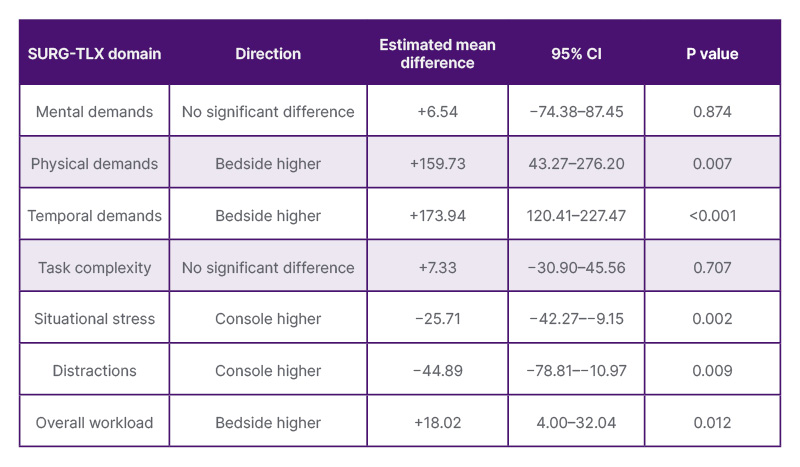
Table 1: Generalised estimating equation analysis of role-related differences in SURG-TLX workload scores.
SURG-TLX: Surgery Task Load Index.
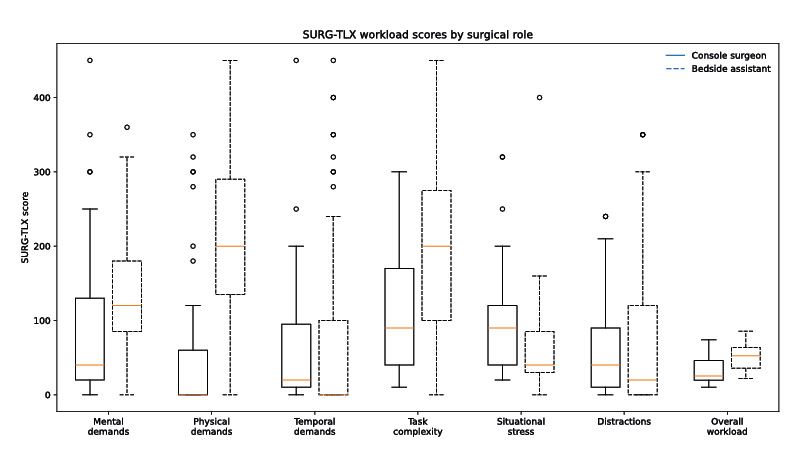
Figure 1: Box-and-whisker plots of SURG-TLX domain and overall workload scores by surgical role.
SURG-TLX: Surgery Task Load Index.
DISCUSSION
The present study demonstrates that intraoperative workload during Senhance robot-assisted radical prostatectomy differs according to surgical role. After accounting for repeated assessments within individual participants, bedside assistants reported higher physical demands, temporal demands, and overall workload, whereas console surgeons reported higher situational stress and distractions. Mental demands and task complexity did not differ significantly between roles. These findings suggest that evaluation of workload in robotic surgery should extend beyond the console surgeon and consider the distinct demands placed on each member of the surgical team.
Robotic platforms have changed the traditional operating room environment by separating console-based operating from bedside tasks.10,22 In the Senhance system, separate robotic arms and additional equipment occupy space around the operating table, while the console surgeon is physically separated from the patient. Based on the authors’ institutional workflow, they speculate that this configuration contributes to different workload profiles between roles. Efficient use of the platform requires familiarity with procedural steps and coordinated communication between the console surgeon, bedside assistant, and nursing staff.
In the authors’ institution, more than 1,200 Senhance robot-assisted radical prostatectomies have been performed by an experienced robotic surgical team. During the procedure, the bedside assistant is responsible for docking, instrument exchange, clip placement, use of advanced bipolar instruments, tissue manipulation, and management of robotic arm collisions. The assistant frequently works between robotic arms in a restricted space. These technical and spatial demands contribute to the greater physical workload observed in the bedside role. Conversely, the console surgeon is physically separated from the operating table and is therefore highly dependent on the bedside assistant and nursing staff. This reduced hands-on control may contribute to situational stress, particularly during intraoperative complications or technical difficulties.
Previous studies using task-load questionnaires have generally reported laparoscopic surgery as more physically demanding than robotic surgery, although findings regarding mental workload are inconsistent.11,26 A meta-analysis of electromyographic studies found lower biceps activation during robotic surgery than during conventional laparoscopy, whereas differences in other muscle groups were less consistent.9 Subjective ergonomic assessments have likewise generally favoured robotic over laparoscopic surgery.27 However, comparisons between surgical modalities do not capture workload distribution within a robotic team. The authors’ findings indicate that the ergonomic advantages experienced by a console surgeon should not be assumed to extend to the bedside assistant.
Physical demands were significantly higher among bedside assistants. The modular configuration of the Senhance robotic arms and the limited working space around the male pelvis may require stretching, reaching across the patient, and prolonged non-neutral positioning. These explanations remain interpretative because objective ergonomic measurements were not performed. Nevertheless, the consistency of the role-related difference after accounting for repeated assessments supports greater attention to bedside ergonomics.
Temporal demands were also significantly higher among bedside assistants in the cluster-adjusted analysis. The authors speculate that the bedside assistant’s need to respond to multiple procedural requests, including instrument exchange, clip placement, camera-related assistance, and management of arm collisions, which may create a greater perceptionof time pressure.
Mental demands and task complexity did not differ significantly between roles after adjustment for repeated assessments. The diversity of bedside tasks could plausibly increase cognitive workload, whereas procedural decision-making at the console may impose a different form of mental demand. The absence of a significant role effect suggests that these domains may be more strongly influenced by individual experience, case characteristics, or specific intraoperative events than by role alone.
Situational stress was significantly higher among console surgeons. Previous research has demonstrated that mental stress during minimally invasive surgery may vary according to surgical interface and operator experience.28 The authors speculate that reduced direct access to the patient and dependence on the bedside assistant during bleeding, impaired visualisation, robotic arm collisions, or technical difficulties may contribute to this finding. The console surgeon remains responsible for procedural decision-making while relying on the bedside team to perform several immediate physical actions. This interpretation is consistent with the role structure of the procedure but should not be considered a direct causal mechanism.
Distraction scores were also significantly higher among console surgeons after accounting for repeated assessments. Potential sources include operating room communication, movement of personnel, and case-irrelevant conversation. Because the present study did not objectively classify or record distraction events, the mechanisms underlying this difference remain speculative.
An important observation was that the role-related workload pattern was also evident among experienced console surgeons who performed both functions. When these participants assumed the bedside assistant role, all three reported greater physical demands, temporal demands, and overall workload than during their console assessments. Moreover, their bedside assessments did not suggest a lower physical or overall workload than that reported by participants who performed only the bedside role; numerically, physical, temporal, and overall workload scores were higher among the crossover participants while working bedside. This pattern argues against the observed bedside workload being explained solely by lesser surgical experience or unfamiliarity with robotic surgery. Rather, it supports the interpretation that the physical and temporal demands are inherent, at least in part, to the bedside role itself.
The higher overall workload among bedside assistants appears to reflect the combined physical and temporal demands of the bedside role. These findings have practical implications for robotic surgical training and operating room organisation. Bedside assistance should be treated as a defined technical role requiring structured preparation rather than as a passive transitional position before console training. Training programmes may benefit from role-specific instruction in instrument exchange, collision management, anticipation of procedural steps, and communication during critical events. Ergonomic assessment of bedside positioning and robotic arm configuration should also be incorporated into local quality-improvement processes.
The choice of workload instrument should also be considered. The authors used SURG-TLX because it was developed and validated specifically for surgical tasks and includes surgery-relevant domains such as task complexity, situational stress, and distractions.25 However, much of the broader workload literature uses NASA-TLX.23,24 Unlike NASA-TLX, SURG-TLX does not include separate performance and frustration domains. These dimensions may capture additional aspects of workload, particularly in settings where the console surgeon has reduced direct access to the patient. The use of SURG-TLX therefore limits direct comparability with predominantly NASA-TLX-based studies and may not capture all relevant dimensions of perceived workload.
This study has several limitations. First, it was conducted at a single high-volumecentre with extensive experience in Senhance robot-assisted radical prostatectomy. Questionnaires were collected after the initial institutional learning curve, between approximately the 300th and 400th procedures. Workload during early implementation may differ substantially because team members are simultaneously acquiring platform familiarity, communication routines, and role-specific technical skills. The present findings therefore primarily reflect an experienced robotic programme and should not be directly extrapolated to centres during initial adoption.
Second, although 98 procedure-level workload assessments were analysed, they were contributed by a limited number of individual participants and the number of questionnaires per participant was unbalanced. The authors addressed intra-individual correlation using GEE with participant-level clustering; nevertheless, the limited number of participants restricts generalisability and may influence the precision of role-effect estimates. Third, workload was self-reported and may be influenced by individual perception, experience, and fatigue.
Fourth, case-level variables that may influence workload, including BMI, prostate volume, nerve-sparing status, prior abdominal surgery, pelvic anatomy, and operative difficulty, were not included in the model. The authors therefore cannot exclude residual confounding by case complexity. Future prospective studies should collect these variables and evaluate their independent association with workload.
Fifth, participant experience was not uniform. Assessments reflected an experienced institutional robotic programme, but individuals differed in their exposure to console and bedside roles. Three participants contributed assessments in both roles, whereas other participants contributed bedside assessments only. Although participant-level clustering accounted for repeated measurements, differences in previous surgical and platform experience may still influence perceived workload.
Finally, the findings are specific to the Senhance platform and extraperitoneal radical prostatectomy. Robotic systems differ in console design, docking, instrument exchange, robotic arm configuration, and the degree of bedside assistant involvement. Workload data from the Senhance platform therefore cannot be directly extrapolated to systems such as the da Vinci surgical system (Intuitive Surgical, Sunnyvale, California, USA) or to other robotic procedures.
Future studies should prospectively evaluate workload across different phases of robotic implementation, incorporate objective ergonomic and intraoperative event measures, and compare role-specific workload across robotic platforms. Multicentre studies with larger numbers of individual surgeons and bedside assistants are required to determine whether the workload patterns observed in this study are platform-specific or represent broader characteristics of robotic team organisation.
CONCLUSION
During Senhance robot-assisted radical prostatectomy, bedside assistants experienced greater physical demands, temporal demands, and overall workload, whereas console surgeons reported greater situational stress and distractions. These role-specific differences support structured bedside-assistant training, deliberate team communication strategies, and ergonomic optimisation of the bedside working environment. The observation that experienced console surgeons showed a similar shift toward higher physical, temporal, and overall workload when performing bedside assistance further supports the role-specific nature of these demands. Future research should evaluate whether targeted training and system-level ergonomic interventions can reduce workload and improve team performance across different robotic platforms and phases of the learning curve.