Key Summary:
- Moist care shortened mean donor site healing time by 3.62 days.
- Pain scores improved from day 4 compared with traditional dry care.
- Anxiety and depression symptoms were less common at 3 months.
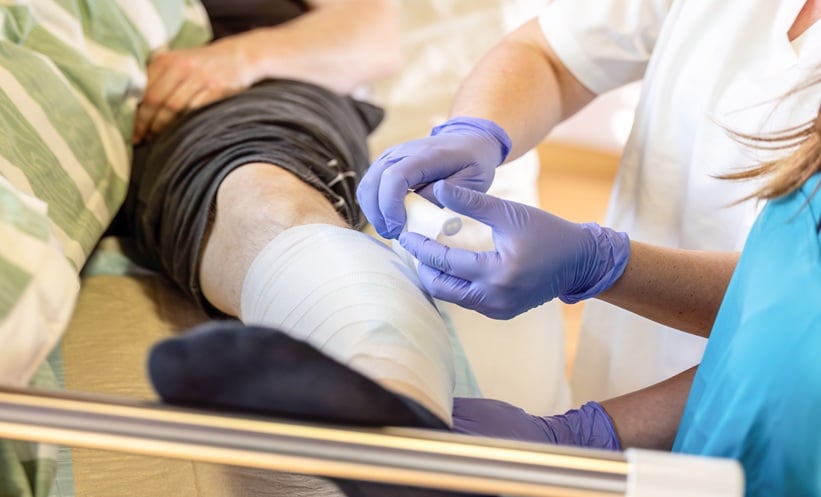
MOIST wound healing shortened burn donor site recovery and eased pain and psychological symptoms after skin grafting.
A retrospective cohort study of 173 adults found that a moisture preserving strategy was associated with faster healing, lower pain scores, and better skin and scar outcomes than traditional dry care using infrared irradiation.
Researchers compared 81 patients who received a liquid dressing with 92 treated using traditional dry care after split thickness skin graft surgery. All donor sites were initially covered with petroleum jelly gauze and a pressure dressing. Beginning on postoperative day 7, patients received their assigned intervention twice daily for 7 days.
Mean donor site healing time was 13.23 days with moist wound healing, compared with 16.85 days under dry care, a difference of 3.62 days. Complete healing during the 7-day intervention period occurred in 35.8% and 17.39% of patients, respectively.
After adjustment for age, total burn surface area, and donor site area, moist wound healing remained independently associated with lower odds of failing to heal within 7 days (OR: 0.624; 95% CI: 0.467–0.765).
Pain scores were comparable during the first 3 intervention days. From day 4 onward, however, patients receiving moist wound healing consistently reported less pain. On day 7, mean scores on the 11-point Numeric Rating Scale were 2.51 with moist care and 2.98 with dry care.
Skin dryness and scar assessments also favored the moist wound healing group at 1 and 3 months. Although differences in Vancouver Scar Scale scores were modest, the findings indicated improvements across features including pigmentation, vascularity, pliability, and scar height.
Recorded rates of donor site infection, significant bleeding, allergic reactions, and partial graft loss did not differ significantly between the groups.
At 3 months, clinically significant anxiety symptoms were reported by 22.22% of patients receiving moist care, compared with 36.96% receiving dry care. Corresponding depression rates were 17.28% and 32.61%.
Greater pain during the intervention was correlated with higher anxiety and depression scores at follow-up. However, the observational design cannot establish that improved wound care directly caused the psychological differences.
The single-center, nonrandomized study may also have been affected by unmeasured differences in analgesic use, nutritional support, infection prevention, and postoperative activity. Larger randomized trials are needed before moist wound healing can be established as superior standard care.
Reference
Miao X et al. Effects of Moist Wound Healing Strategy on Healing Time of Burn Wound Donor Sites and Patients’ Depression/Anxiety Symptoms. Clin Cosmet Investig Dermatol. 2026;19:629626.
Featured Image: Annabell Gsödl on Adobe Stock.
Each article is made available under the terms of the Creative Commons Attribution-Non Commercial 4.0 License.