BACKGROUND AND AIMS
Frozen embryo transfer (FET) has become an integral component of assisted reproductive technology, offering outcomes comparable to or better than fresh embryo transfer while reducing the risk of ovarian hyperstimulation syndrome. Despite advances in embryo culture and endometrial preparation, implantation failure remains a significant challenge. Excessive uterine contractility at the time of embryo transfer has been implicated as a potential cause of implantation failure. Atosiban, a competitive oxytocin receptor antagonist, reduces uterine contractions and may improve implantation outcomes. However, evidence supporting its use has largely been derived from fresh embryo transfer cycles, with limited and inconsistent data available for FET. This RCT aimed to determine whether administration of atosiban prior to FET improves clinical pregnancy rates compared with standard FET protocols alone.1,2
MATERIALS AND METHODS
This prospective RCT was conducted at a tertiary IVF centre in New Delhi, India, between February–September 2025. One hundred women undergoing FET were randomised equally to receive either intravenous atosiban before embryo transfer (Group A; n=50) or standard FET care without atosiban (Group B; n=50).
Eligible participants were 23–35 years of age, had a BMI <30 kg/m², a normal uterine cavity, endometrial thickness ≥7 mm, and underwent transfer of two Grade A blastocysts. Women in the intervention group received a 6.75 mg intravenous bolus of atosiban 30 minutes before embryo transfer. Baseline demographic, hormonal, and ovarian reserve parameters were assessed to ensure comparability between groups. The primary outcome was clinical pregnancy rate confirmed by ultrasonography after a positive serum β-human chorionic gonadotropin test. Secondary outcomes included implantation rate, biochemical pregnancy rate, and first-trimester miscarriage rate.
RESULTS
Baseline demographic and clinical characteristics, including age, duration of infertility, anti-Müllerian hormone levels, antral follicle count, and hormonal parameters, were comparable between the two groups. This similarity strengthens the internal validity of the trial and reduces the likelihood that observed differences were attributable to confounding variables.
Clinical pregnancy rates were significantly higher in the atosiban group compared with controls (58% versus 38%), representing an absolute increase of 20% (p<0.05). These findings suggest that suppression of uterine activity at the time of embryo transfer may enhance reproductive outcomes in FET cycles.
Secondary outcomes also favoured atosiban. Implantation rates were higher in the intervention group (33.3% versus 23.8%), although the difference did not reach statistical significance. Biochemical pregnancy rates were numerically greater among women receiving atosiban (20% versus 14%), while first-trimester miscarriage rates were lower (17.2% versus 21.1%; Table 1). Although these differences were not statistically significant, all secondary outcomes demonstrated a consistent trend favouring treatment. The absence of significance for secondary endpoints likely reflects the relatively modest sample size rather than a lack of biological effect, as all outcome measures moved in a favourable direction.
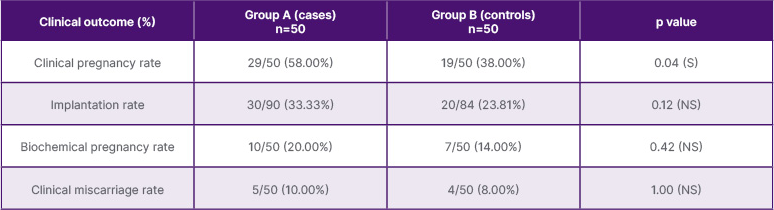
Table 1: Outcome of IVF embryo transfers in the Atosiban treatment group (n=50) and control group (n=50).
Implantation rate = number of gestational sacs/number of embryos transferred.
NS: not significant; S: significant.
CONCLUSION
This study provides evidence that pre-transfer administration of atosiban may improve clinical pregnancy rates in women undergoing FET. The increase in clinical pregnancies, together with favourable trends in implantation and miscarriage outcomes, supports the potential role of uterine contractility suppression in enhancing implantation success. Although limited by its single-centre design and relatively small sample size, the trial addresses an important gap in the literature. Larger multicentre studies are needed to confirm these findings, assess live birth outcomes, and clarify the role of atosiban in routine FET practice.