Key Summary:
- Psoriasis was associated with higher risks of cataract and cataract surgery.
- PUVA and UVB phototherapy were linked to increased odds of cataract.
- Systemic psoriasis treatments were associated with lower odds of cataract.
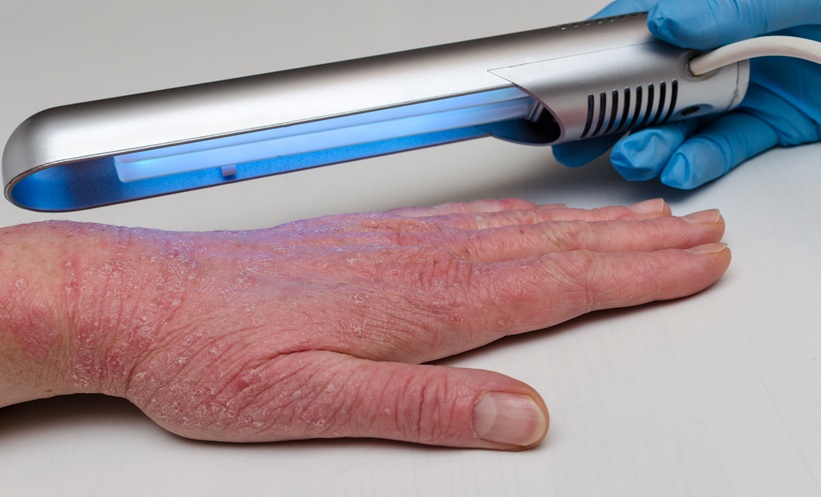
PSORIASIS was associated with increased risks of cataract and cataract surgery, while psoralen plus ultraviolet A (PUVA) and ultraviolet B (UVB) phototherapy were linked to higher odds of cataract, according to a retrospective cohort study using data from Taiwan’s National Health Insurance Research Database.
The study included 61,622 patients with newly diagnosed psoriasis and 61,622 matched controls. Researchers examined whether psoriasis was associated with cataract and cataract surgery, before assessing whether psoriasis treatments, including phototherapy and systemic therapies, were associated with these outcomes.
Patients with psoriasis had a 32% higher risk of cataract compared with matched individuals without psoriasis (adjusted hazard ratio [HR]: 1.32; 95% confidence interval [CI]: 1.24–1.40).
The risk of cataract surgery was also higher among patients with psoriasis (adjusted HR: 1.41; 95% CI: 1.30–1.53). The associations were generally consistent across subgroups based on age, sex and the presence of psoriatic arthritis.
These findings suggest that cataract and cataract surgery may represent additional health considerations for patients with psoriasis.
A nested case control analysis assessed patients with psoriasis who developed cataract or underwent cataract surgery, comparing treatment exposure with psoriasis patients who did not develop these outcomes.
Both PUVA and UVB phototherapy were associated with increased odds of cataract. PUVA was associated with higher odds of cataract (adjusted odds ratio [OR]: 1.88), while UVB phototherapy was also associated with increased odds (adjusted OR: 1.22).
The study did not identify a clear dose response relationship for either phototherapy approach. Similar findings were reported for cataract surgery.
Systemic treatments showed a different association with cataract outcomes. Biologics and Janus kinase inhibitors were associated with reduced odds of cataract (adjusted OR: 0.49), while conventional disease modifying antirheumatic drugs were also associated with lower odds (adjusted OR: 0.74).
Similar associations were observed for cataract surgery.
The findings highlight an association between psoriasis and increased cataract risk and suggest that treatment exposure may also be relevant. The authors reported higher odds of cataract and cataract surgery among patients receiving PUVA or UVB phototherapy, while systemic treatments were associated with lower odds.
Reference
Su YJ et al. Risk of cataract and its association with phototherapy among patients with psoriasis. J Dermatol. 2026;DOI:10.1111/1346-8138.70552.
Featured image: Iri-s on Adobe Stock
Each article is made available under the terms of the Creative Commons Attribution-Non Commercial 4.0 License.